
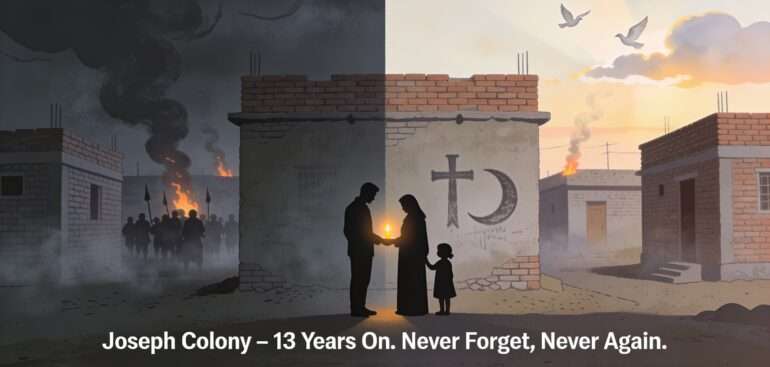
A Day That Changed Lives Forever
Today, March 9, 2026, marks 13 years since one of the darkest days for Pakistan’s Christian community in Joseph Colony. On March 9, 2013, a neighborhood of around 300–500 Christian families, totaling roughly 1,500–2,000 people, was attacked by a furious mob, leaving hundreds homeless, traumatized, and fearing for their lives.
Chaos and Flames: The Day Joseph Colony Was Ravaged
The violence began after an accusation against Sawan Masih, a 26–28-year-old Christian sanitary worker, who was alleged to have insulted the Prophet Muhammad during a private argument. The allegation spread rapidly, and by March 8, police had registered a blasphemy case under Section 295-C of the Pakistan Penal Code. Although Sawan was taken into custody, tensions escalated uncontrollably.
On March 9, a mob of 3,000–4,000 people stormed Joseph Colony, armed with sticks, stones, and clubs. They looted and set fire to homes, shops, and churches—including the Assemblies of God Church and a Catholic church. Over 150–178 homes were destroyed or damaged, 18–20 shops looted, 2 churches attacked, and dozens of Bibles and other religious items were burned or desecrated. Families ran for their lives, often carrying only small children or a few belongings.
Thankfully, no fatalities were reported during the attack itself, though some residents, including the accused’s father, were beaten. By the end of the day, the neighborhood resembled a war zone, with charred remains, collapsed roofs, and destroyed walls.
Silence in the Midst of Chaos
Despite the scale of destruction, police and local authorities did little to intervene. Human rights groups, including the Human Rights Commission of Pakistan, reported that law enforcement either stood by or were instructed to let the mob “vent their anger,” leaving residents vulnerable to unchecked violence.
Justice Denied
In the aftermath, around 150 people were arrested, but justice remained limited. By 2017, an Anti-Terrorism Court had acquitted 115 of the accused due to insufficient evidence, leaving survivors frustrated and without closure. Meanwhile, Sawan Masih was convicted of blasphemy in 2014 and sentenced to death, highlighting the controversial and often abused blasphemy laws.
Although the Punjab government and various NGOs provided aid and helped with reconstruction, many families never fully regained their homes, shops, or livelihoods, and the scars—both physical and emotional—still linger in the community.
Lessons and Legacy
The Joseph Colony tragedy is not just history—it is the story of real people whose lives were upended by fear, hatred, and the misuse of Pakistan’s blasphemy laws. These laws, meant to protect faith, have too often been turned into weapons to target minorities, settle personal scores, and trap innocent people in false accusations. Families lost their homes, their businesses, and their sense of safety overnight. Children still carry the fear in their hearts, and parents live with the trauma of knowing that speaking freely—or even being falsely accused—can put their lives at risk.
Thirteen years later, the survivors of Joseph Colony carry memories of fire and destruction, yet also the quiet strength to keep moving forward. Their courage is a reminder that even in the face of injustice, human resilience can endure.
We remember Joseph Colony today—not just to mourn the past—but to demand a society where no one lives in fear for their faith, where families can sleep safely at night, and where laws meant to protect are never twisted into tools of vengeance. The cries of the innocent from that day still echo, and it is our responsibility to listen, remember, and act.