
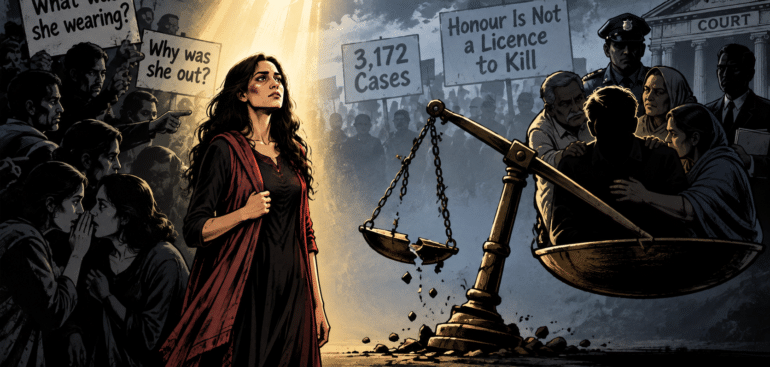
In Pakistan, a woman can be raped and still be asked what she did to cause it. She can be harassed over her clothes, location, or character. She can be murdered in the name of honour. Yet people still debate her choices instead of condemning the crime.
This thinking is wrong.
A woman’s clothes do not cause rape. Travelling at night does not justify assault. Trust does not equal consent. Rejecting a man does not give him the right to attack or kill.
Honour killings are not traditions. They are crimes. They grow from control, entitlement, and the belief that a woman belongs to her family. No father, brother, husband, or relative owns a woman’s life. There is no honour in murder.
The numbers reveal the scale of the crisis. In the first six months of 2026, Pakistan reported 3,172 gender-based violence cases. These included 644 murders, 514 cases of torture, 462 abductions, 363 suicides, 280 rapes, and 132 honour killings.
Punjab reported 74% of these cases. Sindh reported 17%. More than half occurred inside victims’ homes.
Punjab police separately registered 20,114 crimes against women. These included 4,446 rape cases and 940 gang-rape cases. On average, more than 24 rape cases and five gang-rape cases were registered every day.
The actual number may be higher. Many women do not report violence. Fear, shame, family pressure, and distrust of police silence them.
Behind every number is a person.
Five-year-old Ayat Noor was allegedly abducted, sexually assaulted, and killed in Haripur. Her body was found in an unused well. In Karachi, 18-month-old Aizal died after an alleged sexual assault by a teenage relative. In Gujrat, a woman was allegedly raped and strangled by her husband’s nephew. In Lahore, a police official was accused of abducting and assaulting a 20-year-old woman with learning disabilities inside a police station.
Hina Javed, 45, was found dead after allegedly suffering torture by her husband. A TikToker was allegedly killed by her father in an honour-related crime.
These cases follow the same pattern. Men use violence to control women. Society then searches for reasons to blame the victims.
After the 2020 Lahore-Sialkot motorway rape, the then Lahore police chief questioned why the woman had travelled at night. The criminals committed the rape. Yet the victim was forced to explain herself.
Qandeel Baloch was murdered by her brother. Many people still focused on her lifestyle. Noor Mukadam’s murder produced questions about why she trusted the accused. Sana Yousaf, 17, was killed after rejecting a man who refused to accept her decision.
Trust is not consent. Independence is not provocation. A woman’s “no” is not an insult.
These crimes also expose institutional failure. Violence can occur at home, on the street, or inside a police station. Women need trained police officers, proper investigations, forensic support, safe complaint systems, shelters, and faster trials.
Maryam Nawaz has called women and children her “red line”, but that commitment must be measured through arrests, prosecutions, convictions, and safer communities—not speeches.
Families must stop protecting violent men. Silence does not protect honour; it protects the abuser.
Boys must learn that women are not possessions. Rejection is not humiliation. Jealousy is not love. Violence is not strength.
Women do not need more instructions on how to avoid male violence. They need justice, safety, and functioning institutions.
The state must make perpetrators afraid—not women. Women’s safety is a right. Pakistan must stop teaching women how to survive violence and start teaching men not to commit it. Those who commit violence—and those who protect them—must face justice.