
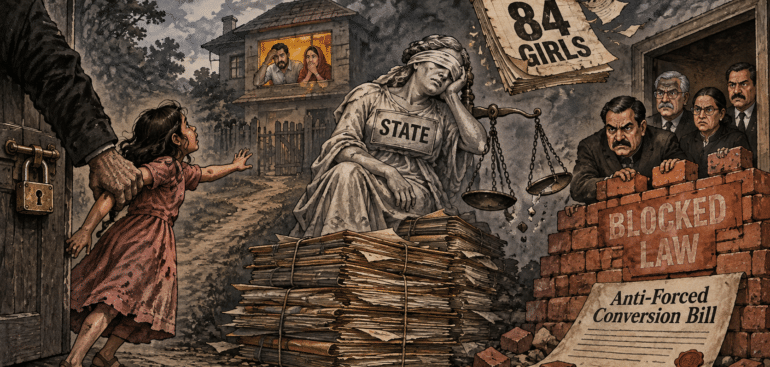
At least 84 girls and women from religious minorities were abducted, forcibly converted and married in Pakistan in the first ten months of this year. Human rights groups say the state has failed to stop these crimes, and that it has failed the families who suffer them.
A Crisis in the Numbers
Of the 84 victims, 49 were Christian and 35 were Hindu. Punjab recorded 47 cases and Sindh recorded 36. Balochistan recorded one. Lahore had the most cases of any district, with 18.
The victims include 43 underage girls, and six of them are younger than 14. Cases involving Christian girls and women have already more than doubled this year compared with all of last year.
Between 2021 and 2025, authorities recorded 515 cases of abduction and forced conversion. Human rights activists say the true figure is much higher.
Behind Every Figure, a Family
Each number is a child taken from her home. She is pressed into a conversion she did not choose and married to a man she did not choose. Her parents search for her, and their fear grows with each day.
Many families never file a complaint. They fear retaliation, and they doubt the system will protect them. Activists say this silence hides the real scale of the problem. It also shows how little the victims trust the state.
Justice Delayed
Human rights groups criticise the slow response of the police and the courts. Delay works against these families. Once a girl has been moved, converted and married, her chances of returning home shrink. Every week of inaction makes recovery harder.
A child cannot give meaningful consent to marriage or conversion. A state that claims to protect its citizens must act on that principle. Instead, many families wait for officials to take their complaints seriously.
Legislation Blocked
Pakistan has tried to pass laws against forced conversion before. Opposition from religious groups defeated those efforts, and lawmakers backed away. The girls bore the cost.
Human rights organisations now demand three things:
- Effective legislation against forced conversion.
- Arrest of the suspects.
- Immediate protection for minority girls.
These demands are modest. They ask the state to enforce rights that its own constitution promises to every citizen.
The Cost of Inaction
Pakistan cannot call itself a safe home for all its people while minority families fear for their daughters. Political caution has delayed reform for years, and girls have paid for that delay.
Authorities must investigate every case promptly and prosecute those responsible. They must also pass a law that protects children from coerced conversion and marriage. Each month of delay means more families searching for missing daughters. The state must decide whether it will protect these girls or keep failing them.