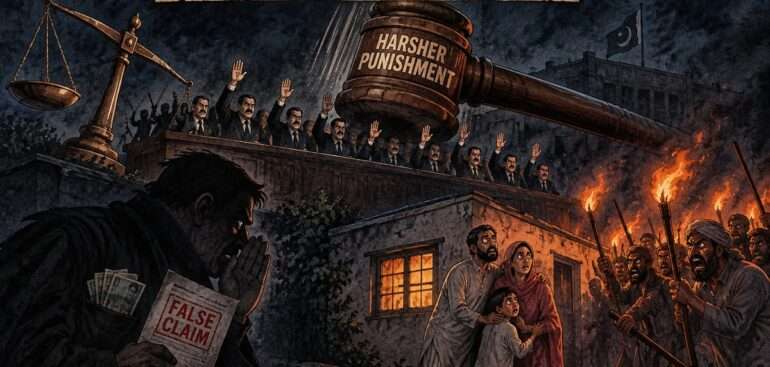
On Tuesday, Nov. 24, the Punjab Provincial Assembly unanimously passed a resolution demanding harsher punishment for blasphemy against the wives, family members and companions of the Prophet Muhammad. Rights advocates warn that it could put more innocent people in danger, because the blasphemy laws are already widely abused.
What the Resolution Says
Opposition lawmaker Rana Aurangzaib introduced the resolution. It calls the current penalty under Section 298-A of the Pakistan Penal Code insufficient. That section allows up to three years in prison, a fine, or both. The resolution urges the federal government to treat the matter as a high priority and to bring in legislation that raises the punishment.
The assembly has no power to change the law itself. A Christian attorney who has defended several falsely accused people said any amendment to Section 298-A needs federal legislation.
A Familiar Push
This effort is not new. In August 2023, parliament passed the Criminal Laws (Amendment) Bill 2023. It proposed a minimum of 10 years for offences under Section 298-A, with the possibility of life imprisonment. It did not become law, because then-President Arif Alvi returned it unsigned.
The Human Rights Commission of Pakistan (HRCP) opposed that bill. It warned that the changes would remove the statutory entitlement to bail for people accused under Section 298-A. Release would then depend on judicial discretion. The HRCP also noted that complaints are sometimes filed under pressure from religious groups, over personal disputes, or out of fear of mob violence.
The Evidence of Abuse
Pakistan’s own officials have admitted the problem. On July 8, provincial home secretaries and senior police officers told the Senate Functional Committee on Human Rights that most of the 333 blasphemy cases registered across the four provinces in five years were fabricated. They said personal vendettas and family disputes often drove the accusations. Many cases collapsed because investigators found no evidence.
Punjab recorded the most cases under Section 295-C, with 116. Sindh recorded 96 cases under Section 295-B and 29 under Section 295-C. Khyber Pakhtunkhwa recorded more than 90 cases, and Balochistan recorded 28. Of those accused, 56 per cent were Muslims and 14 per cent belonged to religious minorities.
A June 2025 Human Rights Watch report, “A Conspiracy to Grab the Land,” found that accusations are used to incite mobs, displace marginalised groups and seize their property. It also found that police often fail to protect the accused. Those who incite violence often escape arrest.
Voices of Warning
A Christian attorney who has defended falsely accused people said the government should punish false accusers instead. He said organized groups use these claims to extort money. Tehmina Arora of Alliance Defending Freedom International said blasphemy laws breed violence and discrimination. She said they violate international law and should be repealed.
The Human Cost
Behind every statistic is a person. An accusation alone can destroy a family, drive people from their homes or bring a mob to their door. Lawmakers have heard from their own police and officials that most cases are false. Yet the assembly chose to threaten the accused with more severe penalties. It did not choose to protect them.
Pakistan needs laws that punish those who lie, extort and incite violence. A unanimous vote for harsher punishment sends the opposite message. It tells the accusers that the state stands with them. It tells the innocent that they stand alone.