
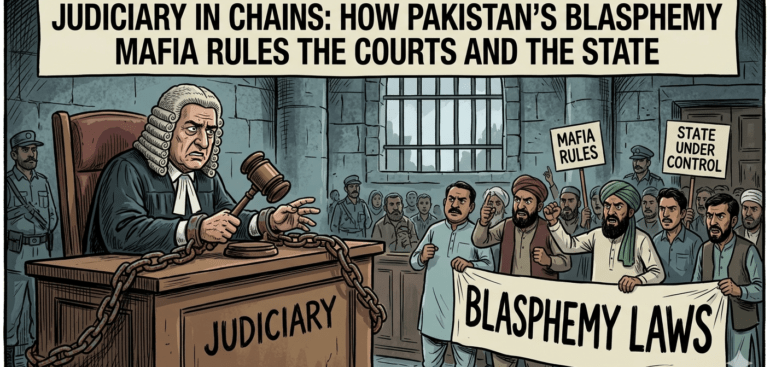
Pakistan’s blasphemy laws have become a tool of systematic coercion, allowing organised religious groups and their allies to intimidate judges, prosecutors, police, and politicians, effectively holding the justice system and wider state machinery hostage. This “blasphemy complex” relies on fear of mob violence, targeted killings, and economic blackmail to paralyse institutions that should protect rights and uphold the rule of law.
Laws designed for abuse
Pakistan’s blasphemy provisions carry a mandatory death penalty or life imprisonment, but their wording is vague and broad, making mere accusations enough to trigger arrest and detention. Human rights organisations have documented that these laws are routinely used to settle personal scores, grab land, and persecute religious minorities, rather than to address genuine incitement or hate speech.
An ICJ report describes blasphemy trials as “fundamentally unfair,” pointing to intimidation of judges and lawyers, denial of bail, prolonged pre-trial detention, and judicial bias against the accused. Acquittals are extremely rare, and hundreds of people accused of blasphemy remain in jail for years without effective hearings because judges fear backlash from religious extremists.
The rise of the “blasphemy gang”
Recent investigations show that blasphemy accusations are not only spontaneous expressions of outrage but, in many cases, the work of organised networks. Human rights lawyers in Pakistan have described a coordinated “blasphemy business group” or “Islamist gang” that manufactures cases, often by circulating allegedly blasphemous content online, then filing complaints and extorting the accused or their families.
According to detailed reporting, a single such group, with links to religious organisations like Tehreek-e-Labbaik Pakistan (TLP) and allied bodies, has been responsible for the vast majority of cases registered by federal investigators since 2021, trapping more than 450 people and allegedly causing multiple deaths from torture in custody. These networks reportedly operate with the complicity of elements within law enforcement, sharing content, lodging complaints, and then using threats of mob violence and legal ruin to extract money or force property transfers.
How the judiciary is coerced
Judges who hear blasphemy cases operate under an atmosphere of direct and sometimes lethal intimidation. Human rights groups document instances where judges have been openly threatened in courtrooms, pressured by crowds outside court premises, and denounced in sermons or social media campaigns when they show leniency or demand solid evidence.
Lawyers defending those accused of blasphemy face similar or greater danger: several have been assassinated, including prominent rights lawyer Rashid Rehman, who was shot dead in his office after defending an academic accused of blasphemy, following explicit threats over his role in the case. Because of these patterns of violence, many lawyers refuse to take such cases, leaving the accused without meaningful legal representation and further skewing proceedings toward conviction or endless detention.
The climate of fear means that judges often deny bail, avoid deciding cases promptly, or pass responsibility upward in the judicial hierarchy to avoid individual blame. Observers note that courts frequently disregard existing procedural safeguards, such as requirements for prompt investigations and protections against false accusations, turning trials into prolonged ordeals where the main function of the judiciary is to manage risk from extremists rather than to deliver justice.
State machinery under pressure
The impact of the blasphemy regime extends beyond courtrooms into policing, bureaucracy, and local administration. Police officers are often unwilling to refuse or delay registering blasphemy cases because of fear that mobs will turn against them or accuse them of blasphemy themselves. In many incidents, mobs have attacked police stations, demanding custody of accused persons, forcing officers to choose between handing over suspects to extrajudicial violence or facing violent confrontation.
Local officials and politicians, particularly at the district level, have on multiple occasions caved in to demands by extremist groups to file cases, evict communities, or look away from vigilante attacks rather than uphold the law. Human rights documentation shows communities—often Christians, Ahmadis, or other minorities—forced to flee en masse after accusations, leaving homes and property behind to be seized by local power brokers and their religious allies.
In this environment, entire organs of the state start to function primarily to avoid confrontation with hardline groups rather than to enforce rights or provide services, effectively turning police, prosecutors, and bureaucrats into hostages of blasphemy politics.
Role of extremist movements
Groups like Tehreek-e-Labbaik Pakistan have built a mass political identity around a maximalist, punitive interpretation of blasphemy, mobilising large sit-ins, street protests, and sometimes violent riots whenever they feel religious sentiments have been offended or courts have shown leniency. These movements question the legitimacy of any state institution that does not endorse their demands, framing judges or politicians who advocate due process as enemies of faith.
International observers note that as such parties gained influence, blasphemy accusations and related violence increased, reflecting the instrumental use of religious outrage for political power. Even when the state bans or restricts these groups, their narratives and networks persist within segments of the legal community, bureaucracy, and street-level mobilisation, continuing the cycle of fear and control.
Human cost and long-term damage
Since 1990, dozens of people have been murdered in Pakistan following blasphemy allegations, often by mobs acting before any court verdict. Hundreds more languish in prison, including in solitary confinement “for their own safety,” while their families face social ostracism, economic ruin, and permanent displacement.
The broader result is a profound erosion of the rule of law: when judges, lawyers, police, and administrators act under constant threat, constitutional guarantees of fair trial, freedom of religion, and freedom of expression become hollow. Leading Pakistani jurists have warned that the judiciary has “completely failed” to prevent abuses of blasphemy laws, and that the legal system is being reshaped around appeasing extremists rather than protecting citizens.
If Pakistan wanted, it could change
The most damning fact is this: the same state that can crush political opponents, censor media, and deploy force at will against peaceful protesters suddenly becomes “weak” and “helpless” when facing the blasphemy gang. That weakness is selective. It proves that Pakistan’s power is intact—but reserved for other priorities. Justice and courage simply are not among them.
If Pakistan truly wanted to end this hostage situation, it could: by repealing or radically narrowing the blasphemy provisions, by protecting and rewarding judges and lawyers who uphold the law, by prosecuting those who threaten courts, and by dismantling the networks that manufacture cases. The reason this has not happened is not inability; it is unwillingness.
Until Pakistan acknowledges its own central role in empowering the blasphemy gang, its judiciary and state machinery will remain captives not only of extremists on the street, but of the cowardice and complicity that sit at the heart of the state itself.