
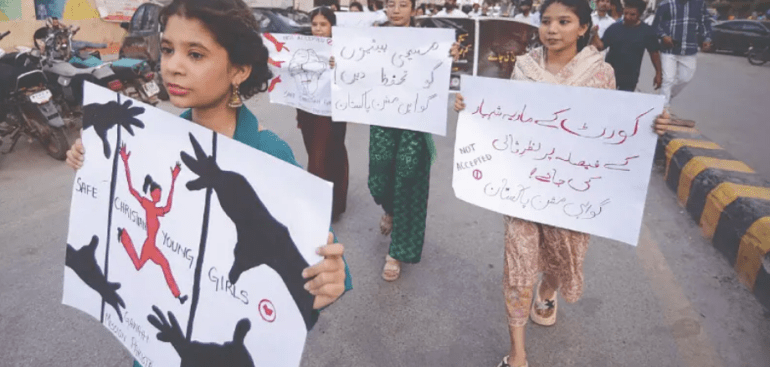
Outside the Karachi Press Club on a warm Sunday afternoon, the chorus of voices grew louder — women clutching hand-painted placards, young girls standing shoulder to shoulder with elders, all united by a single plea: “Protect our daughters.”
Christian organisations and rights activists had gathered in protest, expressing deep concern over what they described as a rising wave of forced marriages and religious conversions involving minor girls from their community. The demonstration, organised separately by the National Christian Party, Gawahi Mission Trust, and other civil society groups, brought together families and faith leaders from across Karachi.
Among those leading the demonstration were Bishop Kashif, Shazia Samoon, Shabbir Shafqat, Pastor Sarfraz William, Parveen Parvez, and Dr. Sultan Sardar Bhatti. Their message was resolute yet layered with heartbreak. “We are a peaceful community,” one speaker said, “but our daughters live in fear — fear of being taken, fear of never returning home.”
The protesters alleged that young girls, some barely in their teens, were being abducted, coerced into converting, and married off to men far older than them. They argued that these incidents were not only a grave violation of human rights but also an assault on the very notion of childhood.
Their demands were clear: enforce the laws already on the books, pass stronger legislation where gaps remain, and ensure the right to safety, faith, and dignity for every citizen — regardless of religion. The demonstrators also pointed to a recent controversial court ruling in the Maria case, which they said had deepened uncertainty and fear within minority communities. “How can a child, who legally cannot obtain her own ID card, be considered mature enough to decide on religion or marriage?” one participant asked, her voice breaking with frustration.
Protesters called upon the chief justice of the Federal Constitutional Court to review the decision, urging Pakistan’s president and prime minister to take immediate notice. Beyond legal reform, they appealed for moral solidarity — for Muslim, Christian, Hindu, and Sikh communities alike to stand together in the face of injustice.
As the sunlight faded, the chants of prayer and protest intertwined. “We are not asking for privilege,” said Dr. Bhatti. “We are asking for protection — for the right of every child to dream without fear.”
In a city accustomed to noise and protest, Sunday’s demonstration left behind a rare hush — a quiet reminder that behind every slogan and statistic lies a story of a family desperate to keep its children safe.