
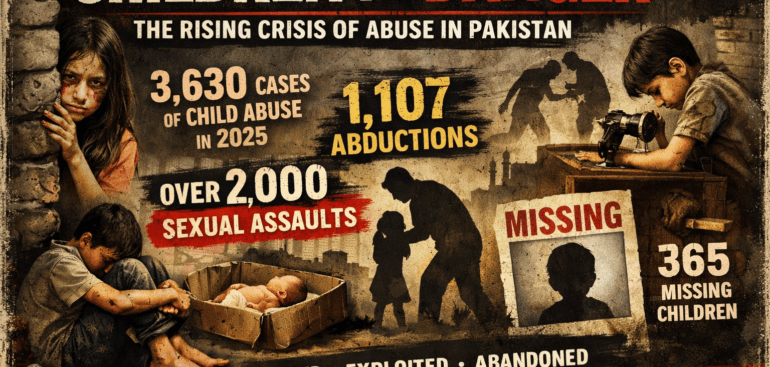
Childhood should be a time of safety, learning, and hope. Yet in Pakistan, countless children are facing a growing crisis of abuse, exploitation, and neglect. According to Sahil’s Cruel Numbers 2025 report, at least 3,630 cases of child abuse were recorded last year—a troubling 8% increase from 2024. This translates to more than nine children abused every single day, and the reality behind these numbers is likely far worse, as many cases go unreported, leaving children invisible to the very systems designed to protect them.
The Face of Abuse
The report dismantles common misconceptions about victims. Girls made up 53% of cases, while boys accounted for 45%, and 116 cases involved infants, some tragically fatally. Children aged 11–15 were the most vulnerable, with boys in this group reporting higher victimization than girls. Students emerged as the largest identifiable group of victims, followed by child laborers and children with special needs.
Sexual abuse remains the most pervasive and brutal form of violence, with 2,003 cases—55% of all reported abuse—falling into this category. Among these, 596 involved sodomy, 522 involved rape, and 238 cases involved gang sexual assault. These figures reveal not just prevalence, but extreme cruelty inflicted on the most vulnerable.
Perhaps most chilling is who the perpetrators are. In the majority of cases, children were abused by people they knew. Acquaintances accounted for 1,667 perpetrators, while family members—including fathers, brothers, and other relatives—were implicated in several cases. Strangers were responsible for 754 cases. The domestic nature of many abuses underscores the betrayal children experience at the hands of those they should be able to trust.
Geography of Pain
The crisis is not uniform across the country. Punjab bears the heaviest burden, reporting 77% of sexual abuse cases. Among districts, Faisalabad led with 553 cases, followed by Kasur, Gujranwala, and Sialkot. Urban areas reported slightly more cases than rural ones, though abuse is a nationwide problem.
Child abduction and missing children further highlight the severity of the situation. In 2025, 1,107 abductions were recorded, with girls making up 71% of victims. Missing children cases rose sharply from 245 in 2024 to 365 in 2025, predominantly involving boys vulnerable to exploitation while fleeing family conflict, school stress, or peer pressure. Infants were especially at risk: 71 were found dead, 27 alive, 15 abducted, and two cases involved the sale of infants. Garbage dumps and hospitals became grim locations where abandoned babies were discovered.
A Glimmer of Accountability
There is a small sign of progress: 1,812 of the 2,003 sexual abuse cases were registered with police, indicating increased reporting and some legal action. Yet, despite this, prevention and protection remain insufficient. Awareness campaigns, school-based child protection education, specialized teacher and police training, and child-friendly courts are urgently needed, but systemic failures remain stark.
A Call for Urgent Action
These numbers are not mere statistics—they are broken lives, betrayed trust, and stolen childhoods. They expose a society struggling to protect its youngest and most vulnerable, where abusers often hide in plain sight, infants are abandoned, and victims’ voices are silenced.
Child rights activists argue that the rise in reported cases reflects both better reporting and persistent failure to prevent abuse. The solution lies in stronger institutional safeguards, coordinated community vigilance, and a cultural shift that refuses to tolerate abuse in any form.
Pakistan cannot afford complacency. Every day without effective action is another day children live in fear. They deserve protection, justice, and the chance to grow up free from harm. Their future depends on how urgently we respond today.