
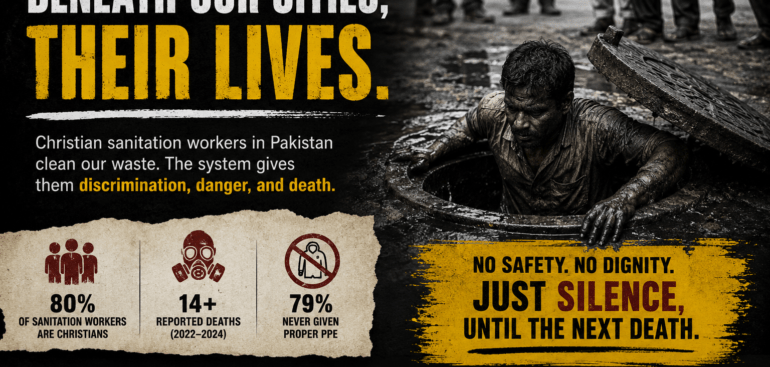
The deaths of Christian sanitation workers in Pakistan are no longer isolated tragedies. They are part of a deadly pattern that exposes how poverty, discrimination, and official neglect continue to trap an entire community in dangerous work that many others refuse to do.
In just over a month, at least six Christian sanitation workers have died while cleaning sewer lines in different parts of the country.
On May 7, 33-year-old Shabbir Masih entered a 25-foot-deep sewer line in Faisalabad and never came out alive. He left behind a wife and three children. Days earlier, Shakeel Masih and Samar Masih died while cleaning another sewer line in Sahiwal district. In April, three more Christian sanitation workers died in Karachi after inhaling toxic gases inside underground drains.
These men were not soldiers in a war zone. They were sanitation workers doing a job essential for every city to function. Yet they entered deadly sewer lines without proper protection, without safety equipment, without modern machinery, and often without any guarantee that they would return home alive.
Their deaths expose an ugly reality Pakistan has ignored for decades.
Christians make up only around 1.37% of Pakistan’s population, yet rights groups estimate that nearly 80% of sanitation workers belong to the Christian community. For many families, sanitation work is not truly a choice. It is the result of generations of discrimination, social exclusion, and blocked economic opportunities.
For years, job advertisements openly carried phrases such as “Christians only” for sanitation positions — a shocking reminder of how deeply this bias is rooted. Even after court orders and public criticism, little appears to have changed on the ground. Workers say the promises of reform exist mostly on paper.
Shafiq Masih, a Catholic sanitation worker from Lahore with more than two decades of experience, described conditions that sound less like public employment and more like survival under neglect. According to him, officials regularly claim workers are provided with protective equipment, but the reality on the ground is very different.
He said many sanitation offices reportedly keep only one protective suit, mainly for display during inspections or media visits. Workers entering poisonous sewer lines are often left with ordinary clothes, no breathing apparatus, and little training.
The consequences are predictable.
Workers suffer from lung damage, infections, broken bones, and deadly exposure to toxic gases. A National Commission for Human Rights inquiry found that nearly 79% of sanitation workers surveyed had never been provided proper protective equipment, while more than half reported serious workplace injuries. The same report documented at least 14 sanitation worker deaths between 2022 and 2024, mostly caused by toxic gases and unsafe working conditions.
Activists and workers insist the actual death toll is likely far higher because many incidents go unreported.
What makes the crisis even more disturbing is how routine these deaths have become. A worker dies inside a sewer. Officials offer condolences. Headlines appear briefly. Promises are made. Then silence returns until the next body is pulled from another manhole.
Minority rights groups are right to say this is not merely a labor issue — it is a moral failure.
No society can claim to value equality while an entire marginalized community is pushed into the dirtiest and most dangerous work without protection, dignity, or basic safety. There is nothing shameful about sanitation work itself. The shame lies in treating the workers as disposable.
Pakistan’s courts and human rights institutions have already acknowledged the crisis. The Islamabad High Court banned discriminatory hiring advertisements. The National Commission for Human Rights has repeatedly demanded reforms and described manual sewer cleaning as a violation of constitutional rights.
Yet workers continue to die because warnings are easier than action.
Authorities praise sanitation workers in speeches but fail to seriously invest in mechanized cleaning systems, strict safety enforcement, medical protections, or fair labor conditions. Instead of ending manual sewer cleaning, the system continues to depend on poor minority workers risking their lives underground every day.
The silence from large sections of society is equally troubling. Many workers say they feel abandoned not only by the state but also by institutions and communities that should be defending them publicly and forcefully.
Pakistan’s sewer deaths are not unavoidable accidents. They are preventable deaths caused by indifference, discrimination, and decades of institutional failure.
The deaths of Christian sanitation workers should shock the conscience of the country. Clean streets and functioning sewer systems should never come at the cost of human lives.
A nation that depends on these workers owes them more than sympathy after death. It owes them safety while they are alive.