
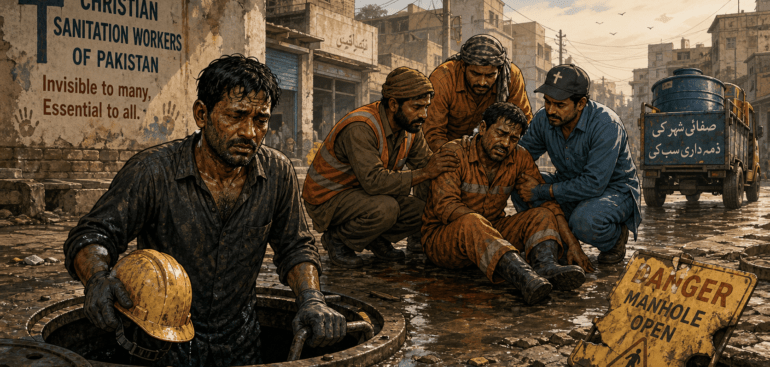
At least six sanitation workers—fathers, sons, and breadwinners—have died in recent weeks in Pakistan’s Punjab and Sindh provinces, their lives cut short not by accident, but by a system that continues to send them into danger unprotected. Another worker still fights for his life, a grim reminder that these tragedies are not isolated—they are part of an ongoing pattern.
On May 7, in Faisalabad, Shabbir Masih climbed down into a sewer and never returned. A father of three, he had not been paid for two months. Poverty left him with little choice but to accept the risk. Inside that manhole, toxic gases overcame him. By the time help came, it was too late. His colleague, Sanwal Masih, survived—but only just, and remains hospitalized.
Just days earlier, on May 4, in Sahiwal, two more lives were lost. Shakeel Masih and Samar Masih entered a manhole without even the most basic protective equipment. They, too, were overcome by poisonous fumes. There were no oxygen masks, no safety harnesses—only silence after they descended.
And in April, in Karachi’s Surjani Town, three workers—Wilson, Waqas, and Nazeer—died together while clearing a blocked sewer line. Three men, working side by side, sharing the same fate in a space that should never have been entered without protection.
Behind each name is a family now grieving, children waiting for fathers who will not come home, and households suddenly stripped of their only source of income.
Rights activist William Pervaiz spoke of Shabbir Masih’s desperation, describing how unpaid wages pushed him into a fatal decision. “He was the sole breadwinner,” Pervaiz said, calling for accountability and immediate compensation for the family. His words echo a wider frustration: how many more must die before responsibility is taken seriously?
Ejaz Alam Augustine, a Christian member of the Punjab Assembly, has also raised alarm—not only at the deaths but at what he describes as a pattern of negligence and deflection. He questioned why a Christian subcontractor, Khalid Masih, is facing legal action while, he claims, others higher up escape scrutiny. For Augustine, this is not just about one case, but about a system that too often shifts blame rather than addressing root causes.
These deaths are not happening in isolation. They sit within a broader reality faced by sanitation workers across Pakistan—most of whom come from marginalized Christian communities. Estimates suggest that around 80% of sanitation workers belong to religious minorities, often pushed into this work through generations of limited opportunity and social exclusion.
A 2025 Amnesty International report laid this reality bare. It described a system where sanitation jobs are informally reserved for non-Muslims, particularly those from historically oppressed castes. Job advertisements themselves have, for years, reinforced this divide, effectively funneling vulnerable communities into the most dangerous and stigmatized work.
For many workers, the risks go beyond toxic gases. The stigma attached to their profession exposes them to social exclusion and, in some cases, even violence. Women sanitation workers face an even harsher reality—caught at the intersection of gender, religion, and class discrimination.
Pakistan’s courts have recognized the severity of the issue. In December 2025, the Islamabad High Court ruled that discriminatory hiring practices must end and that sanitation workers must be provided with proper safety equipment. Justice Raja Inam Amin Minhas noted that more than 70 Christian sanitation workers have died since 1988 due to toxic exposure—a number that continues to rise.
The court’s words were clear: these deaths are not inevitable—they are preventable failures.
And yet, on the ground, little seems to have changed.
The National Commission for Human Rights has now taken the matter further, filing a petition calling for an end to manual sewer cleaning altogether. Their plea highlights what families already know too well—that without enforcement, policies remain words on paper, and workers remain unprotected.
As hearings continue, the urgency grows. Each delay risks another life.
For the families of Shabbir, Shakeel, Samar, Wilson, Waqas, and Nazeer, justice is no longer an abstract demand. It is a question of dignity, of recognition, and of ensuring that no one else is forced to make the same fatal descent into darkness.
Because these were not just sanitation workers. They were men who showed up to do the jobs others would not—men who kept cities functioning, often unseen, and too often, unprotected.
And they deserved to come home.