
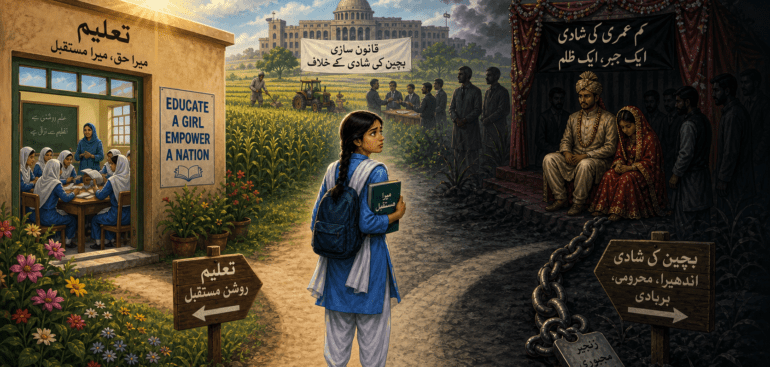
In the fertile heart of Pakistan’s Punjab, where fields promise life and continuity, a quieter, harsher reality persists. According to the Bureau of Statistics, 15% of children here are married before they turn 18. Behind that number are not just statistics, but stolen childhoods—girls pulled from classrooms into lives they never chose.
For years, the law itself reflected this imbalance: 18 for boys, 16 for girls. Even in legislation, inequality was quietly normalised.
The 2026 parliamentary session began fifty-three minutes late. It was a small detail, almost trivial, yet hard to ignore. Punctuality is demanded of children in schools across the country—yet when their futures are debated, time itself seems negotiable. Mujtaba Shuja-ur-Rehman introduced the bill, but what unfolded was more than a legislative process; it was a reflection of who we are as a society.
Minister Azma Bokhari cut through the room with a question that refused to be ignored:
“Those people today, who don’t want restrictions on child marriages for those girls, would you like to marry your daughters at the ages of nine and eleven?”
In that moment, the debate was stripped of abstraction. It exposed a truth many would rather avoid: child marriage is tolerated only when it belongs to someone else’s daughter. It revealed a quiet hierarchy—one where privilege decides whose childhood is sacred and whose is expendable.
Laws, at their core, are meant to protect the vulnerable. Yet here, vulnerability is negotiated, diluted, and rationalised. We comfort ourselves with distance, pretending that injustice is somehow less urgent when it does not knock on our own doors.
But what does that say about us? Are we so detached that we allow cycles of abuse—rape, maternal death, violence—to continue simply because they remain unseen? Have we convinced ourselves that status is earned, rather than inherited by chance?
Opponents of reform rarely defend child marriage outright. Instead, they shift the conversation, invoking religion to pacify and avoid confrontation. Figures like Maulana Fazlur Rehman openly declare, “I will attend marriages of 10-year-olds.” Statements like these do more than provoke—they normalise.
And perhaps the most suffocating barrier of all is fear. Fear of being labelled blasphemous. Fear of questioning interpretations presented as absolute. Under the banner of the “Islamic Republic of Pakistan,” many argue that reform itself becomes a threat.
But this debate was never about faith versus law. It is about responsibility. It is about whether a nation strong in its identity can also be strong in its protection of children.
Across the Muslim world, more than twenty-five countries—and even provinces like Sindh and Balochistan—have set the legal age of marriage at 18. Are they less Islamic, or are they simply more willing to protect their children?
What emerges instead is a dangerous compromise. MPA Zulfiqar Ali Shah proposed “exceptions,” leaving room for courts to decide when a child might still be married. But what is the point of drawing a line if you leave the door open to step around it?
Such loopholes do not soften the law—they hollow it out. They invite exploitation, offering legal cover to those who seek to manipulate it. They ignore the reality of what child marriage inflicts: not just physical harm, but psychological scars that last a lifetime.
One of the most heartbreaking moments came with the withdrawal of Clause 4A, which would have declared child marriages void rather than merely ending them in divorce. This was not just a technical change—it was a lost chance to protect girls from carrying the lifelong stigma of a “failed marriage” they were forced into as children.
Instead, the burden quietly shifts back onto the victim. Proposals to limit how long courts can hear such cases further silence those already trapped by social pressure and fear.
So we are left with an uncomfortable question: can those shaped by privilege truly understand the lives they are legislating for? And in failing to do so, are we reinforcing the very systems that allow exploitation to continue?
Yet, amid the frustration, there was a glimpse of what meaningful reform could look like.
Clause 5A stood out—not for its rhetoric, but for its practicality. By requiring documented proof of age before any marriage is registered, it shifts the law from vague intention to enforceable reality. It closes the gaps where manipulation thrives. It replaces assumption with accountability.
Even as it faced resistance, the Speaker’s decision to embed it into the bill’s rules ensured that, at the very least, some protection would not be lost in debate.
If this law is to matter, it must do more than exist—it must reach the lives it promises to protect. It must bridge the distance between parliamentary speeches and the lived realities of girls across Punjab.
Because in the end, the question is painfully simple: are we ready to be consistent? Are we ready to say, without hesitation or exception, that childhood is not negotiable?
Or will we continue to debate its value—while children continue to lose it?