They are called “conversions” in official records. But behind the paperwork, signatures, and stamped certificates are children—girls barely in their teens—whose lives are being quietly erased.
A recent report titled Stolen Girls, presented at the European Parliament by the Jubilee Campaign, lays bare a reality that is as disturbing as it is systematic. Between 2019 and 2025, at least 210 cases of abduction, forced conversion, and child marriage involving Christian girls in Pakistan have been documented. These are not isolated incidents. They form a pattern—one that reveals deep institutional failures and a cycle of abuse that continues largely unchecked.
The numbers alone are alarming. More than 83 percent of the victims are minors. The average age is just 12.8 years. These are children who should be in school, playing with friends, and dreaming about their future. Instead, they are forced into marriages with men nearly three times their age. The report shows that the average perpetrator is around 35 years old, with age gaps often exceeding 20 or even 30 years.
But statistics, as stark as they are, cannot fully capture the human cost.
Take the case of Maria Shahbaz, a 13-year-old girl from Lahore. Her abduction was reported, and yet the Pakistan legal system has failed her. Despite clear irregularities in the marriage documents—missing identity details and false claims about her age—the court granted custody to the man accused of abducting her. Her parents were left powerless, watching the system validate what they knew was a crime.
Or consider Yarosha Saleem, only 11 years old, whose family waited six months before police even registered a case. By then, the damage had already been done. Delay, in such cases, is not just negligence—it is complicity.
These stories are not exceptions. They are part of a broader mechanism that enables and sustains this abuse.
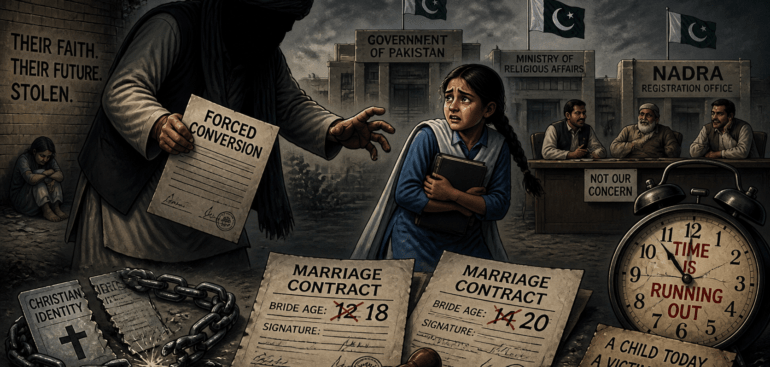
The report outlines a chilling six-stage cycle. It begins with abduction—sometimes through force, sometimes through manipulation. This is followed by forced religious conversion, often conducted under pressure or threat. A marriage is then arranged, supported by a fabricated certificate that falsely declares the child an adult.
What follows is perhaps the most troubling part: the legal validation. Under Section 164 of Pakistan’s Criminal Procedure Code, the child is brought before a magistrate to give a statement. But by this stage, she is often under the control of her abductor, isolated from her family, and vulnerable to intimidation. Unsurprisingly, many state that they converted and married “of their own free will.”
Courts frequently accept these statements at face value. Forged documents go unchallenged. Age discrepancies are ignored. In the end, custody is often handed to the abductor, and then the case is closed. The system, instead of protecting the child, legitimizes her exploitation.
The manipulation does not stop at legal procedures. In 96 percent of cases, victims are given new names after conversion—names that sever their connection to their identity, their family, and their past. This deliberate erasure makes it even harder for parents to locate their daughters or pursue justice.
Punjab province emerges as the epicenter of this crisis, accounting for nearly 89 percent of reported cases. Cities like Lahore and Faisalabad dominate the data, suggesting that this is not confined to remote or underserved regions. It is happening in urban cities, in plain sight.
Equally troubling is the role of unregulated actors. The report highlights how local religious groups, political organizations, and informal welfare bodies issue conversion certificates without oversight. These documents, though often legally questionable, carry enough weight to influence court proceedings.
At its core, this is not just a legal issue. It is a human rights crisis.
The repeated failure of institutions—police, courts, and administrative bodies—creates an environment where perpetrators act with near impunity. Families are left to navigate a system that seems stacked against them, while victims are denied both protection and a voice.
The recommendations put forward by the report are clear and urgent. Laws must explicitly criminalize forced conversions. Child marriages must be declared void without exception. Age verification must rely on official state records, not easily manipulated documents. Most importantly, accountability must extend to those within the system who enable these injustices through inaction or complicity.
There is also a pressing need for safe shelters, legal support, and psychological care for survivors—spaces where they can begin to rebuild their lives away from coercion and fear.
But beyond policy and legislation lies a deeper question: how many more children must disappear into this system before meaningful change occurs?
Each case documented in Stolen Girls represents a life interrupted, a childhood stolen, and a family left searching for answers. These are not just numbers in a report presented in distant halls of power. They are urgent calls for justice.
Ignoring them is no longer an option.