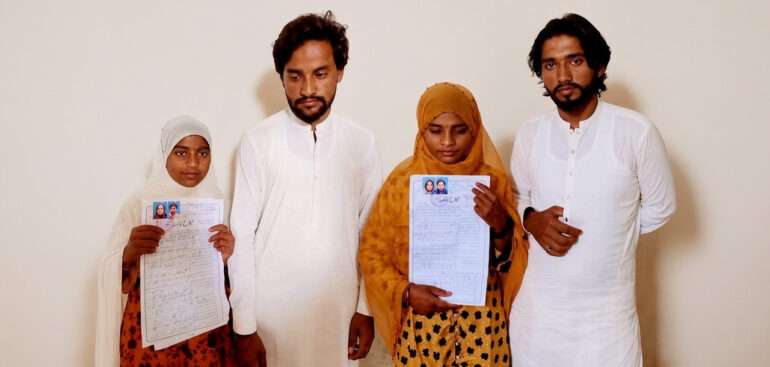
The case of two minor Hindu sisters, ages 13 and 14, from Ibrahim Colony in Tando Allahyar has renewed concern over the safety of Hindu girls in Sindh. Minority families there repeatedly report fears of abduction, forced conversion and child marriage.
The sisters, Roopi and Seeta, are daughters of Raamji from the Kachhi Kolhi community. Their family alleges that abductors took the girls, forcibly converted them to Islam and forced them to marry two Muslim men, Amjad Solangi and Mansoor Solangi.
Reports state that authorities presented the girls before a court in Tando Allahyar in connection with an abduction case. The court sent the girls to a safe house instead of immediately returning them to their family.
Outside the court, the sisters appeared visibly distressed. People present reported hearing them repeatedly appeal to return home. In a video circulating online, the girls say: “Let us go to our parents” and “We want to go home.”
Their plea has raised serious questions about whether authorities have properly assessed their safety, freedom and wishes. The girls’ family says both are minors. Public reports describe them as 13 and 14 years old, although authorities have not publicly verified their ages through birth certificates, NADRA records or other official documents.
If authorities confirm the reported ages, both girls qualify as children under the Sindh Child Marriages Restraint Act, 2013. The law defines a child as anyone under 18 years old. It makes child marriage a criminal offence and treats offences under the Act as cognizable, non-bailable and non-compoundable.
Authorities must therefore establish the girls’ ages immediately through reliable records. They must also investigate when the girls disappeared, who took them, where they stayed, whether they travelled voluntarily, and under what circumstances any claimed conversion or marriage occurred.
The family’s allegations of abduction, forced conversion and forced marriage remain allegations until police and courts establish the facts through evidence. However, the seriousness of such claims requires an urgent, independent and transparent investigation.
The state must interview Roopi and Seeta in a child-sensitive environment, away from alleged husbands, religious figures, intermediaries or anyone who could pressure them. Officials must allow the girls to speak freely and must provide them independent legal support and protection.
This case has caused deep anxiety among Hindu communities in Sindh. Sindh hosts Pakistan’s largest Hindu population, particularly in rural districts where many Hindu families face poverty, caste discrimination and weak access to legal help.
Rights groups have documented a continuing pattern of alleged abduction, conversion and marriage involving minority girls. Data cited by the UK government from the Centre for Social Justice recorded at least 421 alleged cases involving minority girls and women between 2021 and 2024; 282 victims were Hindu and 72 percent of cases were reported from Sindh. In 2024 alone, authorities recorded at least 83 cases, with Hindu girls making up 63 percent of victims.
UN experts warned in 2026 that nearly 80 percent of reported cases involving alleged forced conversion through marriage in Pakistan during 2025 occurred in Sindh, while about 75 percent of victims were Hindu.
Not every religious conversion or interfaith marriage is forced. Adults have the right to choose their religion and marriage partner freely. But a child cannot be treated as an adult, and authorities must examine any claim of consent carefully where allegations of abduction, coercion or intimidation exist.
Roopi and Seeta’s reported call to return home demands attention. Their protection, age, dignity and freedom must come before every other consideration.