
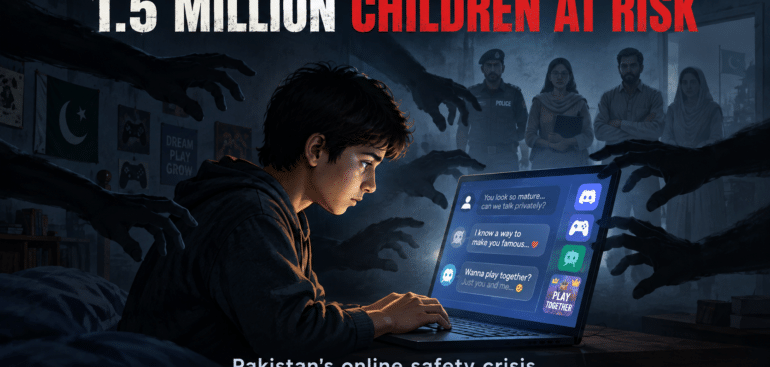
Nearly 1.5 million children in Pakistan experienced online sexual exploitation or abuse during a single year, according to a UNICEF report. The children were between 12 and 17 years old. This number is equal to about one in every 16 children in this age group who use the internet.
The report presents a serious warning about the dangers children face online. Many children received unwanted sexual messages or pictures. Some were asked to send private images. Others faced threats, blackmail or the sharing of their pictures without permission.
The report also raised concerns about artificial intelligence. Children’s photographs can be changed into fake sexual images and videos. These images can then be used to threaten, shame or control them.
One victim, identified as “Zara Shah”, was targeted while playing a computer game. Her name was changed to protect her identity. She was 17 when she began chatting with a stranger during the game.
At first, the man behaved like a friend. Later, he asked Zara to send nude pictures. When she refused, he threatened to find her family online and tell them about their conversations.
Zara feared that her family would blame her. She also worried that she might be stopped from going to school or leaving the house. Because of these fears, she did not report the abuse. Her experience shows that online threats can have serious effects on a child’s education, freedom and mental health.
The UNICEF report found that around 85 per cent of the perpetrators were known to the victims. This means that many children were not targeted only by unknown people. In some cases, the abuser was a friend, an online contact or someone who had gained the child’s trust.
The abuse often began with a simple conversation. Some offenders met children through online games or social media. Others offered gifts, money or promises of friendship and romance. After gaining their trust, they asked for private pictures or began making threats.
The numbers about reporting are also deeply worrying. Around 71 per cent of affected children did not tell anyone about what happened. None of the children surveyed reported the abuse through formal channels, such as the police, helplines or social workers.
Fear, shame and social pressure were among the main reasons for their silence. Many children feared punishment from their families. Some worried that their communities would blame them instead of the abuser. Others may not have known where to seek help.
Nearly 74 per cent of Pakistani children aged 12 to 17 use the internet. As internet access grows, children are spending more time on social media, gaming platforms and messaging applications. However, protection systems have not developed quickly enough to match this growth.
Pakistan already has laws against online crimes involving children. However, experts say that these laws are not properly enforced. Weak investigations, limited awareness and gaps in the legal system allow many offenders to escape punishment.
A ban on social media for children may appear to be a solution, but it cannot solve the deeper problem. Children may find ways around such restrictions, while online abuse can also occur through gaming platforms and private messaging services.
The government must strengthen law enforcement and create simple, safe reporting systems. Police officers, teachers, social workers and parents should receive proper training. Technology companies must respond quickly to complaints and remove abusive material.
Families also have an important role. Children should be taught how to protect their personal information and recognise dangerous behaviour. At the same time, they must be assured that they will not be blamed if they become victims.
The responsibility lies with the abuser, not the child.
Online sexual abuse is not a virtual problem. Its consequences are real. It can damage a child’s confidence, education, relationships and mental health. The figure of 1.5 million victims should not be treated as a distant statistic. Behind it are millions of children who may be living with fear, shame and unanswered questions.
Pakistan must act urgently. Every child should be able to use the internet without facing threats, manipulation or exploitation.