
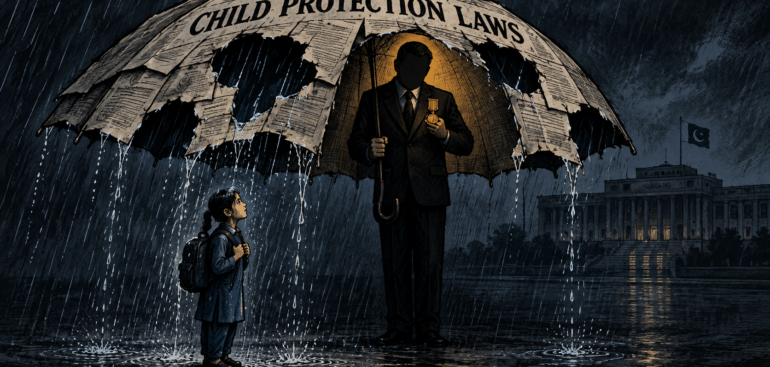
A child’s home should offer safety. When it becomes a place of abuse, the failure reaches far beyond its walls. It exposes a society that struggles to protect its youngest members and institutions that too often respond only after harm has occurred.
According to the figures attributed to child-rights organisation Sahil, Pakistan recorded 1,914 crimes against children between January and June 2026. These included 1,015 cases of child sexual abuse. Behind every recorded case stands a child whose suffering no statistic can fully describe.
These figures demand more than public sorrow. They demand accountability.
When Familiar People Become a Threat
The reported findings challenge the comforting belief that danger usually comes from strangers. Nearly 45 per cent of incidents occurred inside victims’ own homes, while 43 per cent of accused individuals were known to the children. Girls accounted for 58 per cent of reported victims.
These figures describe a painful betrayal of trust. Children depend on adults for protection, shelter and care. When someone within their familiar surroundings harms them, speaking out can mean risking the very relationships on which they rely.
A protection system cannot simply wait for a frightened child to approach the authorities. Governments must create reporting channels that children can understand and use safely. Schools, healthcare services and local protection bodies must recognise warning signs and act without exposing children to further danger.
Awareness campaigns matter, but they cannot replace a reliable response.
A Law Cannot Search for a Missing Child
The reported implementation failures surrounding the Zainab Alert, Response and Recovery Act, 2020 raise particularly serious questions.
Parliament passed the law following the rape and murder of seven-year-old Zainab Ansari. Her name became a symbol of national grief and a demand for change. Yet, according to the account provided, the Islamabad High Court was informed in June 2026 that the mandated alert agency had still not been established.
If accurately reported, this represents six years of failure to turn a legal promise into operational protection.
A law cannot coordinate a search by itself. Officials must establish the responsible institutions, assign trained staff, release funds and ensure that agencies share information quickly.
Invoking a murdered child’s name while leaving essential protections unfinished compounds the failure. Families need functioning services, not another assurance that authorities will act.
A Small Decline Is Not Proof of Progress
The reported total fell from 1,956 cases in the first half of 2025 to 1,914 in the corresponding period of 2026—a difference of 42 cases.
That decline alone does not establish that children became safer. Sahil compiles its figures from newspaper reports, which cannot capture incidents that never reach journalists. Changes in reporting may also affect the totals.
Authorities should therefore resist presenting a marginal reduction as a policy success. They must demonstrate whether children can report abuse more safely, whether investigators handle complaints effectively and whether survivors receive timely support.
Punjab accounted for 80 per cent of recorded cases and Sindh for 15 per cent. These shares demand scrutiny, but they do not, by themselves, establish where the underlying risk is greatest. Uneven reporting can obscure the picture.
Turn Concern Into Responsibility
Authorities cannot claim progress simply because the reported total fell by 42 cases. Nor can they treat passing a law as the completion of their duty. If the agency mandated under the Zainab Alert Act remained unestablished six years later, those responsible owe the public an explanation—not another promise.
This is a failure of accountability. Governments that demand credit for passing child-protection laws must accept responsibility when they leave those protections unfinished. A state cannot honour Zainab by putting her name on legislation while failing to build the system that legislation promised.