
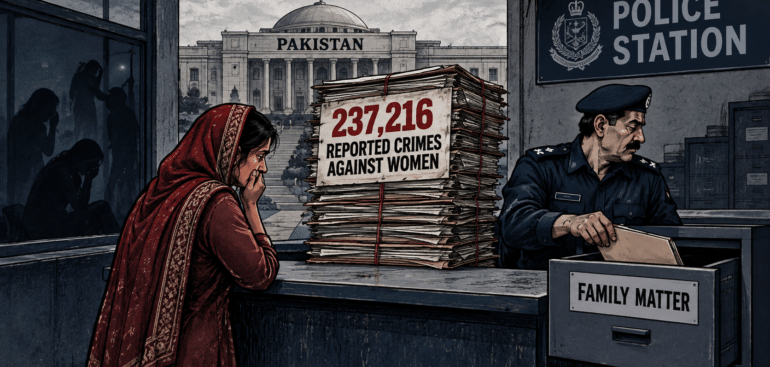
Pakistan recorded 237,216 reported crimes against women and girls between 2021 and 2025, according to the Peace & Justice Network’s National Gender-Based Violence Crime Report. Yet this number is not the full measure of national shame. It is only what reached a police station before fear, distance, stigma, or institutional indifference stopped the rest.
The state should not treat these figures as statistics. It should treat them as evidence of a system that repeatedly fails women.
Punjab accounts for 195,787 cases, or roughly 82.5% of all police-reported GBV crimes, despite holding about 51.5% of Pakistan’s population. This does not prove that Punjab is uniquely violent. It proves that Punjab’s reporting channels are comparatively more visible.
The report itself warns that police data captures only formally reported incidents and likely undercounts the true scale of violence. In other words, Pakistan’s real crisis is larger than its official record.
That is the cruellest part: in provinces and regions where women face the greatest isolation, the numbers look smaller. Silence is not safety. It is erasure.
Punjab recorded 14,824 domestic violence cases, including 3,746 killings; it also reported 830 honour killings, 442 burning cases, and 20,560 sexual violence cases between 2021 and 2025.
These are not isolated tragedies. They reveal a society in which violence follows women from their homes into public life and then into a justice system too slow, too weak, and too indifferent to protect them. A woman should not need to be murdered before the state recognises that she was in danger.
Sindh recorded 25,107 GBV cases, with 19,289 kidnappings and abductions—about 77% of the province’s reported gender crimes. This is not merely a law-and-order problem. It is a demonstration that women can be taken, coerced, and disappeared while the machinery of justice struggles to respond.
Sindh deserves credit for publishing crime data by category and location, but transparency without protection is not justice. A dashboard cannot shield a woman from a tribal council, a violent household, or a police station that treats her complaint as a family dispute.
Khyber Pakhtunkhwa reported 10,210 cases, despite representing a much larger share of the population. Of 2,334 domestic violence cases, 1,197 ended in murder.
That pattern is horrifying. It suggests that abuse becomes visible to the state only when it becomes fatal. Beating, threats, confinement, and psychological control remain hidden behind the excuse that “family matters” should stay inside the home. Pakistan has turned privacy into a shield for perpetrators.
Balochistan recorded 3,108 cases; Azad Jammu and Kashmir recorded 1,572; Gilgit-Baltistan recorded only 161, including just seven rape cases over five years. These figures do not describe peaceful regions. They describe places where policing is limited, geography is punishing, and social pressure makes disclosure dangerous.
When a state cannot count violence, it cannot prevent it. When survivors cannot report safely, the state effectively tells them that their suffering does not exist.
Pakistan has passed laws against rape, harassment, and domestic violence. Yet legislation means little when survivors face hostile police stations, delayed medical examinations, weak investigations, social retaliation, and courts that move too slowly. The report’s proposed National Gender Justice Safety Net—district-level legal aid, forensic support, survivor protection, integrated data, and trained female officers—must become a practical reality, not another policy document.
Pakistan does not have a women’s safety problem alone. It has a governance failure, a policing failure, and a moral failure. Every unreported case is a woman the state failed to reach. Every delayed investigation is a perpetrator it failed to deter. And every woman who fears going to the police is proof that Pakistan’s promise of equal citizenship remains unfinished.