
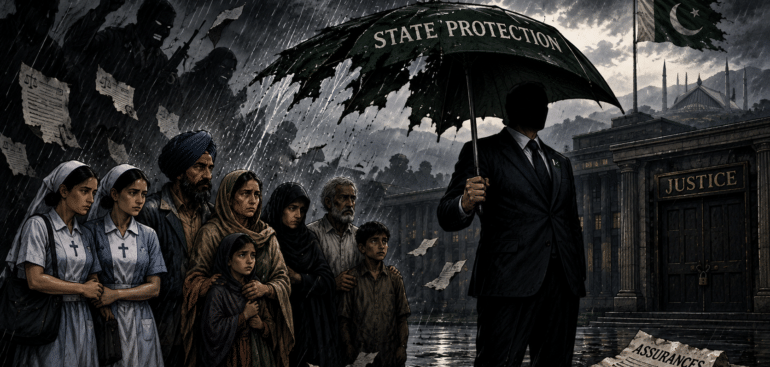
During the first half of 2026, religious minorities in Pakistan continued to face blasphemy accusations, targeted violence and alleged forced conversions. The cases described in the supplied USCIRF account highlight the human consequences of discriminatory laws, weak accountability and inadequate state protection. Behind each case stands a person or family whose suffering demands more than official assurances.
Blasphemy Accusations and Their Lasting Consequences
The cases of Christian nurses Navish Arooj and Maryum Lal illustrate how an accusation can disrupt lives long before a court reaches its verdict. Authorities arrested both women in April 2021 after a colleague accused them of defiling a sticker bearing an Islamic inscription. They spent five months in detention and subsequently went into hiding.
According to the account, a court acquitted them in February 2026 after finding inconsistent witness testimony and insufficient credible evidence. Their acquittal represented an important correction, but it could not erase years of insecurity.
Other cases followed a similar pattern. The Lahore High Court reportedly acquitted Nadeem Masih, a 49-year-old blind Christian man, in June after prosecutors failed to establish the allegations against him. In July, the court also acquitted Dennis Albert, a Christian rickshaw driver accused of desecrating the Qur’an.
For Amir Peter, however, no acquittal came. The account states that the 60-year-old Christian man died in custody in July after spending nearly a year imprisoned on blasphemy accusations. His death raises serious questions about custodial safeguards and the treatment of accused individuals.
Attacks on Religious Communities
Violence compounded the insecurity created by legal persecution. According to the account, ISIS-K claimed responsibility for a February suicide bombing at a Shi’a mosque in Islamabad that killed an estimated 32 people and injured more than 100.
In June, an unidentified gunman reportedly killed three Ahmadis outside a mosque in Chenab Nagar. The same month, an attacker killed a Sikh gurdwara’s caretaker and his wife in Khyber Pakhtunkhwa. Authorities later arrested a police officer in connection with that attack.
These incidents require separate, evidence-based investigations. Together, however, they underscore the urgent need to protect religious communities and hold attackers accountable.
Forced Conversion Allegations Demand Serious Investigation
The cases of Maria Shahbaz, Neha Faqir and Sonia Tariq raise troubling questions about consent, child protection and access to justice.
The account states that a court upheld the marriage of Maria, described as a 12-year-old Christian girl, to a 30-year-old man accused of kidnapping her. Neha’s family alleged that a man abducted her from a sewing centre and forced her to convert, while police initially delayed action.
Sonia’s family also alleged abduction and forced conversion. Judges reportedly questioned a birth certificate identifying her as 15, while her alleged abductors claimed she was 20.
Authorities must investigate such allegations promptly, assess age evidence fairly and hear girls’ accounts without intimidation.
Accountability Must Replace Assurances
Christian lawmaker Falbous Christopher’s proposed legislation against forced religious conversion offers a possible step towards stronger safeguards. Yet legislation cannot protect vulnerable people unless police, courts and public officials enforce it fairly.
Pakistan’s religious minorities need more than acquittals after prolonged suffering or promises after deadly attacks. They need institutions that prevent abuse, respond promptly and deliver justice. Their safety is not a concession from the state; it is the state’s responsibility.