
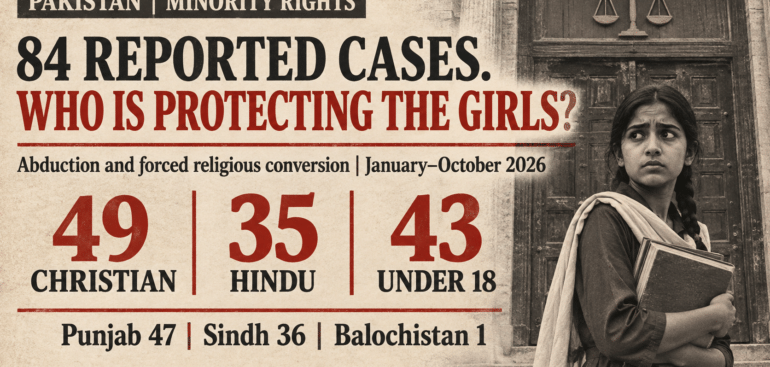
A girl should carry schoolbooks, not the burden of proving she deserves protection. Yet many Christian and Hindu families in Pakistan live with a terrible fear: their daughter could disappear, and the institutions responsible for protecting her might fail to bring her home.
The Centre for Social Justice (CSJ) documented 84 reported cases of abduction and forced religious conversion involving minority girls and women between January and October 2026. Its November 3 update identified 49 Christian and 35 Hindu victims. These figures demand more than official statements. They demand action that protects those at risk and holds offenders accountable.
At least 43 victims were under 18. Six were younger than 14, and 37 were aged 14 to 17. Another 31 were adults, while the ages of 10 could not be established. Behind these numbers are children whose education has been interrupted, families searching for answers and girls whose safety should never have been in doubt.
Punjab recorded 47 cases, followed by Sindh with 36 and Balochistan with one. This marks a change from the previous five years, when Sindh accounted for about 70 percent of documented cases and Punjab for 28 percent. Punjab’s higher total demands serious investigation, not another promise to look into the problem.
Lahore alone recorded 18 cases. Authorities cannot dismiss these abuses as problems confined to remote areas. They must explain how girls disappear, who helps arrange their alleged exploitation and why families struggle to get timely help.
Courts have a particular duty when cases involve disputed ages, consent and allegations of force. A conversion statement or marriage certificate should never close an investigation into whether a child was abducted, threatened or pressured. Police and judges must check age records, examine the evidence and ensure that girls can speak safely, away from anyone accused of harming them.
The case of Maria Shahbaz raises serious questions about these safeguards. The Federal Constitutional Court upheld the marriage of the 13-year-old Christian girl to her alleged abductor before agreeing to review its decision. Her family’s lawyer challenged the ruling, citing official records showing that she was underage.
A review may correct a legal error, but it cannot return the time a child loses while waiting for protection. When a girl’s safety, education and future are at stake, delay is not a minor procedural matter.
Authorities must also distinguish between an adult’s free decision to change religion and a conversion obtained through threats or pressure. Freedom of belief includes both the right to convert and the right to refuse. It must never be used to shield exploitation.
CSJ documented 515 cases between 2021 and 2025. Its latest figures are based on reported and verified cases and remain subject to updates. They do not show the full scale of abuse, but they give authorities more than enough reason to act.
Parliament should examine the proposed legislation regulating religious conversions without delay and ensure that it protects both children and freedom of belief. Police must respond quickly when someone is reported missing, preserve evidence and investigate anyone suspected of arranging or enabling abuse. Courts must provide safe accommodation, independent legal help and proper checks on age and consent.
Adult women’s choices must also be respected. Protection must not become an excuse to force women back into family custody or prevent freely chosen relationships.
Pakistan’s institutions cannot claim to defend minority rights while leaving families to fight for the most basic protection. A missing girl should not need a media campaign before police take her case seriously. A child should not have to overcome a marriage certificate to have evidence of abuse examined.
If authorities fail to investigate credible complaints, ignore age records or allow cases to drag on without effective protection, they are not merely failing to solve a problem. They are allowing those accused of exploitation to benefit from institutional weakness. Official concern means little when families are left to carry the risk. The test is whether institutions protect the vulnerable and hold offenders accountable—not how strongly officials condemn abuse after another girl disappears.