
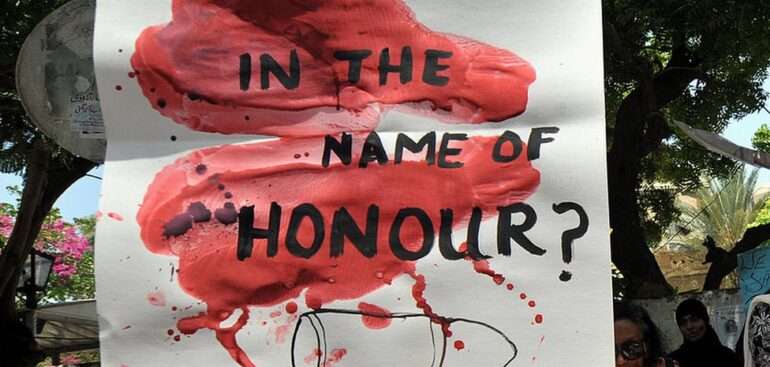
Shikarpur woke up to another tragedy on Wednesday — one that tore through the walls of a family home and echoed across a society already burdened by countless similar stories. Fifteen-year-old Sumaira, a girl whose only “sin” was talking to someone on the phone, was shot dead — allegedly by her own cousin, Gulzar Bhutto — in what police describe as an “honour” killing.
In the narrow lanes of Dawan Shah locality, her name now lingers as a whisper of mourning. Witnesses recall the wails of women breaking the quiet afternoon as police arrived to find Sumaira’s body inside her home, riddled with gunshot wounds. She was the daughter of Amanullah Bhutto — a child, a student, and a dream extinguished before it had the chance to bloom.
Police officials say they found three suspects fleeing the scene, armed and unrepentant. The FIR, lodged at the New Faujdari police station, names Gulzar as the prime suspect along with two unidentified accomplices. Their alleged motive — that Sumaira had spoken to her maternal cousin on the phone, something Gulzar could not tolerate.
“There were no men in the house when he opened fire on her,” an officer said quietly, his words stark in their simplicity. “He believed she had dishonoured him.”
As investigators continue their search, one suspect — Gulzar’s father — is in custody. But the two men accused of pulling the trigger remain free.
For Sumaira’s aunt, Hajani, the shock is still unreal. “We have no idea who killed her or why,” she said through tears. “We only knew she was gone.”
The larger picture: A crisis deepening
Sumaira’s killing is not an isolated tragedy. It is another entry in Sindh’s growing record of violence against women — a crisis deepening in silence. Between January and June 2025, police records show over 3,500 cases of violence against women across the province, including 201 so-called honour killings. Every day, on average, 23 women endured violence. And yet, convictions remain almost nonexistent: just 20 cases led to punishment — less than 1 per cent.
Shikarpur itself has become one of the deadliest districts for women, ranking second in the province for honour killings. Thirty-two cases were reported there last year; only one resulted in a conviction.
Behind each statistic lies a story like Sumaira’s — a young woman denied control over her own life and dignity. Her voice, like so many others, was drowned out by the false morality and patriarchal codes that mistake control for honour.
When honour kills
Human rights defenders have long said these crimes have nothing to do with honour — they are about control, fear, and impunity. Each time the system fails to deliver justice, it signals to others that a girl’s life can be taken without consequence, that suspicion is enough to justify murder.
Sumaira’s death, like hundreds before hers, demands not just outrage but accountability. It demands that society stop labelling these killings as “honour” and start calling them what they are — murders.
In Shikarpur, under the soft light of dusk, Sumaira’s family mourns a daughter who will never return home. Her laughter and quiet defiance live on only in memory. Her death should not fade into another case file or news item. It should be the cry that forces those in power to act — and to finally give meaning to the justice that has so long been denied.