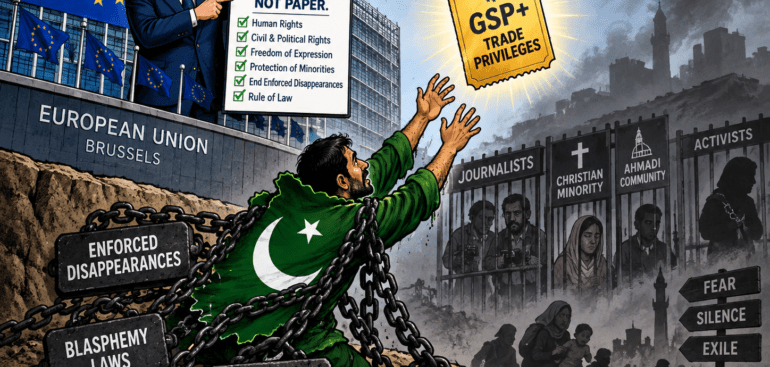
Pakistan’s access to the European Union’s GSP+ trade scheme is not guaranteed beyond 2029, and Islamabad now faces a blunt reality: deliver real human rights progress or lose hundreds of millions in tariff benefits. The EU ambassador, Raimundas Karoblis, made this clear in late August 2026, stressing that legal ratification of UN conventions no longer suffices—Brussels will judge on-ground implementation.
What GSP+ Means for Pakistan
Under GSP+, Pakistan enjoys extensive tariff preferences on exports to the EU, with benefits estimated at around €732 million annually, particularly for textiles. The scheme explicitly ties trade access to the implementation of international conventions on human rights, labour standards, environment, climate and governance. Pakistan has ratified all 27 required conventions—and even the 32 that will apply under the new framework—but the EU now demands proof that these commitments work in practice, not just on paper.
Where Pakistan Falls Short
Karoblis identified clear “red zones” where Pakistan has regressed since gaining GSP+ in 2014. He cited enforced disappearances, extrajudicial killings, curbs on freedom of expression, pressure on journalists, and the rights of religious minorities as principal concerns. The EU’s July 2026 GSP+ report, together with UN monitoring bodies, raises “serious doubts” about effective implementation in these areas.
Religious minorities bear a heavy burden. Blasphemy accusations continue to target Christians and Ahmadis, often sparking mob violence, forced displacement, and attacks on homes and churches. Karoblis welcomed some bail releases in Islamabad and Sindh but flagged Punjab as a major worry, with roughly 500 people still ensnared in blasphemy-related cases. He also condemned the activity of so-called “blasphemy gangs” and singled out the Ahmadi community for urgent protection of life, worship, and basic rights.
Forced conversions and child marriages compound the problem. Minority girls are allegedly abducted, forcibly converted to Islam, and married to older men, while weak institutions hinder recovery and legal remedies. The EU has pressed for marriage registration and documentation reforms, warning these must advance before the next GSP+ application cycle.
What Happens If Pakistan Fails?
If Pakistan does not reapply or fails to meet conditions, it would not lose all preferences but would revert to ordinary GSP. Tariffs would remain about 30 percent lower than standard rates applied to countries like China and the US, yet they would be significantly higher than under GSP+, hitting exporters—especially textiles—with duties of roughly 9–12 percent on goods that now enter duty-free.
The Bottom Line
Brussels is not asking Pakistan to adopt European standards; it is asking for faithful implementation of UN conventions that Pakistan itself ratified. The message is blunt: trade privileges depend on measurable progress, concrete action plans, and verifiable results—particularly for minorities, journalists, and detainees. Without that, Pakistan’s “golden ticket” to EU markets will expire.