
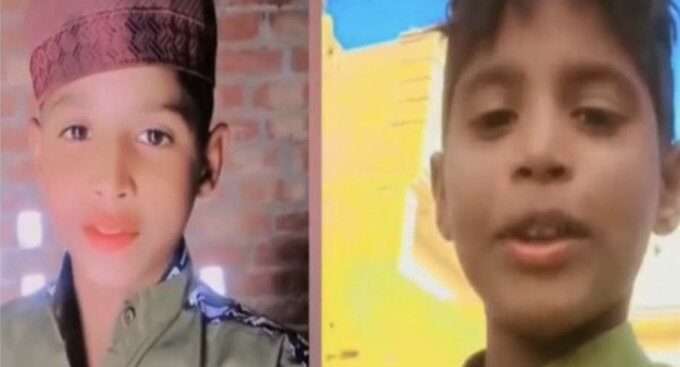
In the quiet fields of Pancho Baig Kotla village, the cries of a father echo in anguish — a cry for justice, for faith, for his lost son. Fourteen-year-old Jameel Masih, a child of the Christian minority in Pakistan’s Sheikhupura District, has become another name in the endless list of victims whose innocence has been crushed under the weight of power and prejudice.
Born into poverty, Jameel’s family had little choice but to let him work at a local landlord’s cattle shed. His father, Sharif Masih, a daily wage laborer, agreed to a heartbreaking arrangement — his son’s labor in exchange for five maunds of wheat a year. It was not enough to live with dignity, but survival leaves little room for choice.
For five long years, Jameel toiled under Muhammad Boota Bajwa, a wealthy landowner in Punjab Province. Then, on February 22, Jameel’s parents went to see their boy — only to be told that he no longer wished to meet them. They begged, they cried, and only after local elders intervened did Bajwa reluctantly release the boy.
But their reunion lasted barely a few hours.
Under the cover of darkness, Bajwa returned — this time with guns and force. He dragged Jameel away from his parents’ trembling hands as their screams pierced the night. Since that night, the boy has not been seen again.
Days later, a TikTok video surfaced — Jameel, wearing an Islamic cap, a Muslim hymn playing in the background. To his grieving parents, it felt like watching a piece of their son’s identity being paraded as proof of ownership. Local whispers confirmed their worst fear: Jameel had been forcibly converted to Islam.
With help from HARDS Pakistan, a Christian advocacy group, Sharif Masih filed a complaint at the local police station. Yet, as with too many such cases, justice moves slowly — if at all. Sohail Habil, the group’s chief executive, condemned the act as a gross violation of human rights, pledging to take the matter to the Lahore High Court. “The Masih family has been subjected to extreme injustice,” he said. “We will not rest until this child is recovered.”
Human rights activists say Jameel’s case reveals the dark intersection of poverty, faith, and feudal power. Napolean Qayyum, a noted activist, explains that forced conversions are often a disguise for bonded labor. “When minority children are converted, it’s rarely about faith — it’s about control,” he said. “And Pakistan still has no federal law criminalizing forced conversions of minors.”
Tragically, stories like Jameel’s are not rare in Pakistan’s Christian and Hindu communities. In Sindh and Punjab, rights groups like the Human Rights Commission of Pakistan (HRCP) continue to document cases — most involving young girls who vanish, only to reappear as claimed converts and child brides.
For Jameel’s parents, life has turned into a slow, torturous wait — no sleep, no peace, only the haunting memory of their son’s smile. Every knock at the door makes their hearts race. Every moment of silence feels heavier than before.
In a land where the strong often dictate the fate of the weak, one question remains painfully unanswered: How many more children must lose their innocence before justice awakens?