
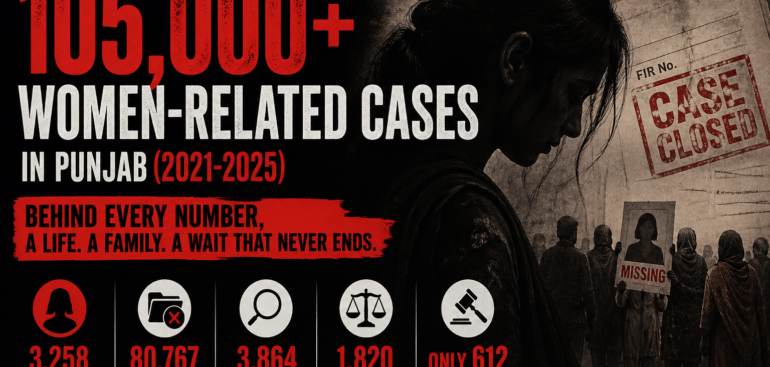
A deeply troubling picture has emerged from Punjab, where newly submitted data to the Lahore High Court reveals the scale of women-related cases between 2021 and 2025. During this period, 105,571 cases were registered—an average of more than 21,000 each year, nearly 1,750 every month, and around 60 cases every single day.
These are not just numbers. Each case represents a woman—a daughter, sister, or friend—whose life abruptly became part of a legal record.
A significant portion of these cases—over 70,773—were filed under Section 365, relating to abduction. Yet what raises deeper concern is that 80,767 cases were later cancelled. For many families, cancellation does not bring closure; instead, it often leaves behind uncertainty, silence, and unanswered questions.
According to the report, in nearly 77% of cases—approximately 80,000 women—the individuals appeared before courts stating they had left home voluntarily, often for marriage. Legally, this is recorded as consent. However, the reality behind such decisions can be far more complex. Social pressure, family expectations, fear, and limited choices can all shape decisions that may not reflect true freedom.
Even as thousands of cases are formally closed, the human impact persists. The data shows that 3,864 cases remain under investigation, while 3,258 women are still untraced. These figures represent families still waiting—hoping for a call, a message, or any sign of return.
Additionally, 1,432 cases involve named suspects but remain unresolved, and 1,820 are delayed due to legal or procedural challenges. In contrast, only 612 women have been recovered and presented before courts—a small figure compared to the overall scale.
Authorities have instructed police officers to improve investigations and warned of strict action against negligence. However, for affected families, official directives offer little comfort in the absence of real answers.
What makes the situation even more concerning is how easily such figures risk becoming normalised. Over 100,000 cases should never feel routine. Each one marks a moment of disruption—when a woman disappeared, left under uncertain circumstances, or became part of a system that often struggles to fully explain what happened.
Behind the 3,258 untraced women are families living with ongoing uncertainty—watching doors, checking phones, and holding onto hope despite the passage of time.
This issue goes beyond statistics, legal codes, and administrative processes. It reflects the lived experiences of women whose stories are often reduced to files and entries, and of families left carrying the emotional weight of unresolved loss.
In the end, while the numbers are staggering, the human cost is far greater