
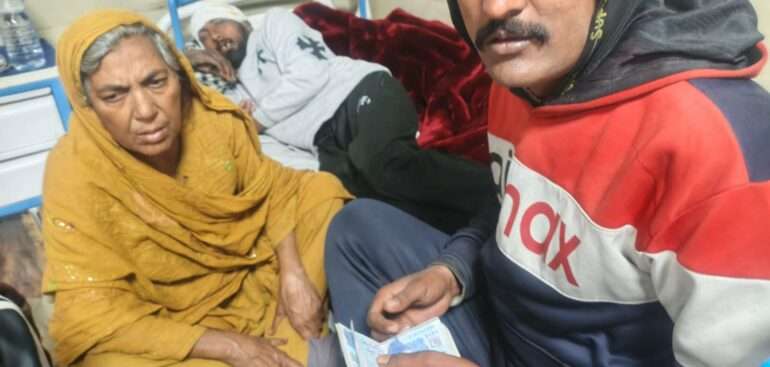
In a quiet village near Sialkot, a young man’s life was nearly destroyed—not because of a crime, but because he arrived late to work.
Tanveer Masih is 24 years old. He is a Christian. He has lived with an intellectual disability since childhood. And on 18 January, he was subjected to a level of cruelty that no human being should ever endure.
Tanveer worked as a farmhand, feeding cattle for a powerful local landlord in Bambanwala village. That morning, he arrived later than usual. What should have been met with patience—or at the very least restraint—was instead answered with rage.
His employer began shouting abuse. Then the violence started.
Tanveer was beaten mercilessly with wooden rods and bricks. Blow after blow landed on his body—his head, his back, his hands. His skin was torn open. His finger was fractured. His knee swelled so badly that he could no longer stand. Blood soaked his clothes.
When the beating finally stopped, Tanveer was not taken to a hospital. He was not offered help. He was abandoned in open fields, broken and helpless, unable to walk.
Only later did a relative find him and rush him to a hospital in Daska.
Medical examinations revealed the extent of the damage:
- Severe head injuries
- Deep wounds across his back, with skin torn away
- A fractured index finger on his left hand
- Extensive swelling across his body, including his knee
Tanveer was left bedridden, traumatised, and unable to move freely. His disability—visible in his mannerisms and speech—made the attack all the more disturbing. He was not only assaulted; he was targeted because he was vulnerable.
The pain did not end at the hospital.
Despite clear medical evidence of brutal assault, the family’s attempt to seek justice was met with indifference and intimidation. At the local police station, officers refused to register a formal complaint. Instead of initiating legal action, they pressured the family to “settle” the matter quietly.
The accused is influential in the area. His business stands prominently near the police station itself. The message was clear: power matters more than justice.
For a poor family with no connections, no money, and no voice, the law became another locked door.
This was not an isolated incident.
For over six years, Tanveer had worked under harsh conditions despite his disability. He was made to perform heavy physical labour without a fixed salary, receiving only a few hundred rupees a day—barely enough to survive.
His limitations were never accommodated. Instead, they were exploited.
Tanveer lives with his elderly mother, Bashiran Bibi, his brother Babar, and his sister Nabila. Their home has no running water, no washroom, and no security. Survival is a daily struggle.
Babar earns a meagre living selling miswak sticks on the street. The family was already living hand-to-mouth. After the attack, even that fragile balance collapsed.
Tanveer can no longer work. Medical costs are mounting. Fear hangs over the household.
Tanveer’s story is not just about one brutal beating. It is about how poverty, disability, and religious identity collide to leave people completely defenceless.
It is about how a vulnerable young man can be beaten nearly to death—and then denied justice—because the person who hurt him is powerful.
And it is about how, in many rural corners of Pakistan, Christian labourers remain expendable, invisible, and unprotected.
Tanveer survived the attack. But survival should not be the only measure of justice.
His wounds may heal. The question is whether a society that allowed this to happen will ever confront the cruelty it continues to ignore.