Every year on International Women’s Day, the world celebrates progress, empowerment, and the resilience of women. Speeches are delivered, campaigns are launched, and powerful slogans about equality echo across the globe. Yet behind these celebrations, uncomfortable realities often remain hidden in the shadows. Some stories rarely receive the attention they deserve, and some voices remain painfully unheard.
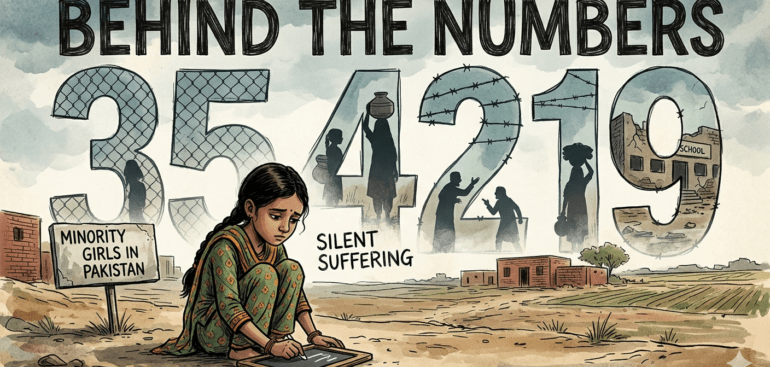
One such troubling reality emerges from reports documenting abductions and forced religious conversions of minority girls and women in Pakistan between 2021 and 2025. According to the data highlighted in the poster, 515 cases were reported in five years. At first glance, this may appear to be just another statistic in a report. But behind every single number lies a human story—a frightened girl, a devastated family, and a community living under constant fear.
The figures reveal a deeply disturbing pattern. Hindu girls account for 69% of the victims, followed by 31% from the Christian community, while a very small number of cases involve Sikh girls. These numbers reflect the vulnerability of minority communities that already live on the margins of society. When a community lacks social influence and institutional protection, its most vulnerable members—especially young girls—often face the greatest risks.
Even more alarming is the age distribution of the victims. More than half—52%—are between 14 and 18 years old, while 20% are under the age of 14. These are not adults making informed life choices with full freedom and awareness. These are children—girls who should be sitting in classrooms, preparing for exams, laughing with friends, and dreaming about their futures.
Instead, many girls disappear into circumstances they neither chose nor understood. For their families, the nightmare begins with an empty doorway—a mother waiting long after sunset, a father searching the streets with growing fear, and a night filled with unanswered calls and quiet despair. What follows is often a painful struggle for justice, where desperate parents hear their daughter has “converted” or “married willingly.” Yet when the girl is still a child, such claims raise heartbreaking questions about how much choice she ever truly had.
Human rights observers have repeatedly raised concerns about such situations. Reports suggest that many victims are pressured or manipulated into conversions and marriages, often in circumstances where minority families lack the resources or influence to challenge the situation legally. In some cases, courts have even validated such marriages and conversions, leaving families devastated and powerless.
Research and documentation by the Centre for Social Justice (CSJ), a Pakistan-based human rights organization, underline the seriousness of the issue. Their reports have recorded hundreds of cases of abduction and forced conversion of minority girls, many of whom were minors. These findings highlight the urgent need for stronger legal safeguards and institutional accountability.
Yet what makes the issue even more troubling is the silence that often surrounds it. A case might briefly spark outrage in the media or on social networks, but the attention quickly fades. Another story replaces it, and the previous victims quietly disappear from public conversation. Meanwhile, the cycle continues.
For minority communities, this silence can feel like abandonment. It sends a painful message—intentional or not—that their suffering does not command the same urgency or empathy.
At the bottom of the poster appears a simple yet powerful message: “Every Minority Girl Deserves Freedom, Dignity, and Protection.” These words should not remain merely a slogan printed on awareness posters. They represent a fundamental principle of human rights—that no child’s safety should depend on her religion, social status, or community identity.
Addressing this issue requires more than sympathy or occasional outrage. It demands stronger legal protections for minors, transparent investigations, accountability for perpetrators, and meaningful safeguards for vulnerable communities. Above all, it requires society to listen to the voices of victims and their families—voices that too often go unheard.
Behind every statistic is a young girl who once dreamed of a future—and those dreams deserve protection.