Every year, as Eid al-Fitr approaches, a familiar pattern unfolds in Pakistan. While millions prepare for prayer and celebration, the Ahmadiyya Muslim Community braces for restrictions, uncertainty, and, too often, outright denial of their right to worship.
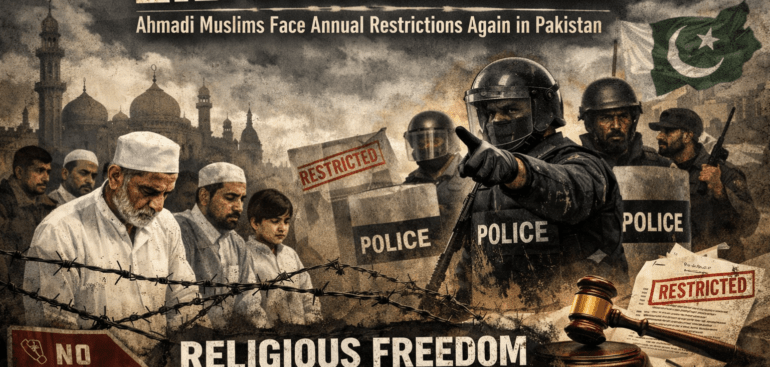
This year was no different. In several districts of Punjab, Ahmadis were once again prevented from offering Eid prayers. Police deployments, administrative barriers, and the looming threat of legal consequences ensured that gatherings were either disrupted or never took place at all. What should have been a moment of unity instead became another episode in a cycle of exclusion.
This repetition is what makes the situation especially troubling. These are not isolated incidents or sudden lapses—they are part of a consistent, almost predictable reality. Year after year, Ahmadis face the same restrictions, the same pressures, and the same message: that their participation in public religious life is not permitted.
The roots of this pattern lie in Pakistan’s legal framework, which formally restricts Ahmadi religious practices. Over time, these laws have shaped not only policy but also public attitudes, normalizing discrimination and enabling local authorities to act against the community with little resistance. What is enforced on paper translates into lived experiences of fear and marginalization.
Equally concerning is the role of the state in sustaining this cycle. Law enforcement agencies are meant to ensure safety and protect rights, yet they often become instruments of restriction. By intervening in peaceful acts of worship, authorities reinforce exclusion rather than challenge it. This repeated conduct raises serious concerns about accountability and the rule of law.
For the Ahmadi community, the impact goes far beyond missing a single prayer. Eid is a deeply meaningful occasion—one that symbolizes belonging, faith, and togetherness. Being denied the right to celebrate it openly, year after year, deepens a sense of isolation. It turns a moment of joy into a reminder of inequality.
What makes this pattern even more striking is its contradiction with official narratives. Pakistan has repeatedly pledged to uphold religious freedom and counter extremism. Yet, the annual restrictions on Ahmadis tell a different story—one where commitments remain largely unfulfilled on the ground.
The justification often offered—that such measures are necessary to maintain public order or respect majority sentiment—does little to mask the underlying injustice. Public order cannot be sustained by excluding a minority from basic rights. In fact, such actions only deepen divisions and perpetuate intolerance.
The Ahmadiyya community continues to call for what should be fundamental: the right to worship, enforcement of legal protections, and accountability for those who enable discrimination. Their demands are not extraordinary—they are rooted in the basic principles of equality and human dignity.
As another Eid passes under the shadow of restriction, the question remains: how long will this cycle continue? A society cannot claim to value justice while allowing the same violations to repeat year after year. Until this pattern is broken, the promise of equal rights in Pakistan will remain not just unfulfilled, but routinely denied.