
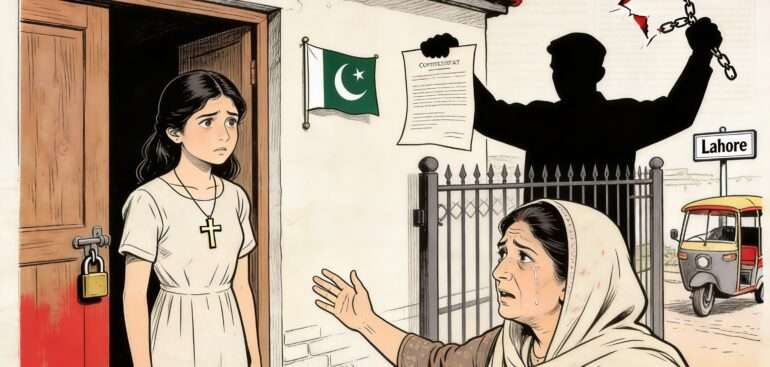
In a narrow street of Shahdara, Lahore, the cry of a mother cuts through the ordinary hum of life — a cry for a daughter lost not to death, but to confinement and cruelty. Eighteen-year-old Saniya, a Christian domestic worker, was allegedly held captive in her employer’s home for eight long months — months defined not by work, but by isolation, fear, and deep injustice.
Her mother, Salma, a resilient widow earning her living through daily wage labour, recalls how her daughter slowly disappeared from her world. “I could reach her only once,” she says, her voice trembling. For eight months, Saniya was reportedly denied the simple freedoms every human being deserves — the right to rest, to visit home, to laugh freely, or to hear her mother’s reassuring voice. Even the agreed wage of Rs. 15,000 was reduced to Rs. 8,000 — her labour undervalued, her dignity denied.
When Salma fell gravely ill in December and pleaded for her daughter’s return, her request met silence. Then, the silence turned to cruelty. Saniya’s employer allegedly cut off all communication. When Salma tried to see her child, she was told Saniya had been moved elsewhere — her whereabouts unknown. Desperation turned to horror when, on March 29, Salma was allegedly told her daughter would only be released if she paid Rs. 250,000 — a sum far beyond the reach of a labourer’s trembling hands. When Salma said she could not pay, the employer’s family reportedly demanded she send her younger daughter, Rimsha, instead.
This chilling demand — an attempt to barter one child for another — shattered the thin line between exploitation and trafficking. Salma’s tears became her only witness as she struggled to comprehend the papers she had been pressured to sign — contracts that stole her child under the guise of employment.
It was only when a local pastor heard her story that hope flickered again. He connected Salma with The Edge Foundation, whose team acted swiftly. On March 31, they visited the family, documented every painful detail, and initiated legal proceedings. Today, a petition lies before the Lahore High Court, urging Saniya’s recovery and protection. The organisation continues to bear every legal and logistical cost — a small light in the darkness that surrounds so many like her.
But behind this individual tragedy looms a chilling truth: countless young women across Pakistan suffer similar shadows of exploitation. Domestic workers — especially those from marginalised communities — remain largely voiceless, with little recourse when trapped by power, poverty, and silence.
Saniya’s case is more than one family’s trauma; it’s a mirror reflecting the unchecked injustices endured by vulnerable girls who toil behind closed doors. As legal proceedings unfold, one question hangs in the air: how many more Saniyas remain unseen, unheard, and unfree?