
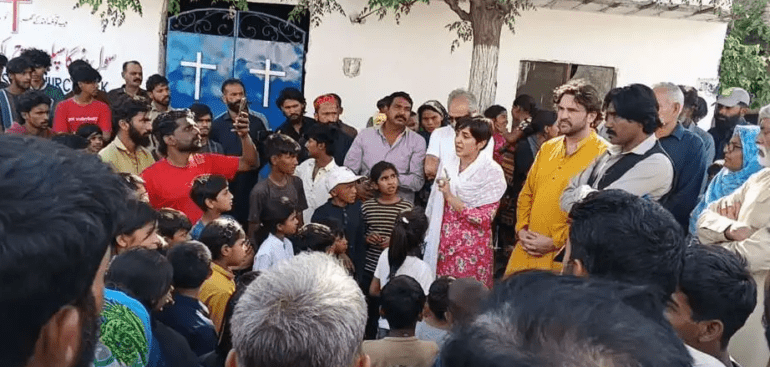
Tears, prayers, and defiance filled the narrow lanes of Allama Iqbal Colony on April 13, as hundreds of Christian families stood together to protect the only homes they have ever known.
For five tense hours, the residents — men, women, and frightened children — faced down bulldozers sent by the Capital Development Authority (CDA), refusing to yield to another attempt to erase their community. What began as a routine morning turned into a nightmarish battle for dignity and survival.
Panic spread swiftly when CDA officials, flanked by police and a magistrate, entered the colony with demolition orders in hand. Dust rose in the air as machinery roared to life, and the cry, “Stop! These are our homes!” echoed through the streets. Mothers clutched their children while fathers dragged their few possessions out of threatened houses.
Authorities retreated after fierce resistance, but not before breaking locks, sealing a scrapyard, and painting ominous red “X” marks across ten homes and two small shops — symbols of destruction still to come. To the people of Allama Iqbal Colony, those crude marks were not just warnings; they were the visible wound of a system that has failed to see them as human beings.
The colony, also known as Shopper Colony, shelters about 1,300 families — mostly Christians — many of whom have lived there since the early 2000s. Most earn a living as domestic workers, sanitation staff, or daily laborers. Despite serving the city faithfully, they are now being pushed out of it.
“We have been living here since 2003. Where should we go?” asked Nasir Malhi, a father of three and a daily-wage worker. Standing outside his two-room home built on a 50-square-meter plot, he wrestled with hopelessness. “We will not leave,” he said firmly. “There are no jobs, and inflation is already crushing us.”
This struggle is not new. Islamabad’s Christian settlements — four of them recently marked for demolition — have faced repeated threats of eviction. Authorities cite “illegal occupation,” but residents say they will not move without fair compensation or an alternative site to rebuild their homes.
Community leaders and rights groups, including the Awami Workers Party Rawalpindi-Islamabad (AWPRI) and the Catholic Church’s National Commission for Justice and Peace (NCJP), rushed to stand by the beleaguered families. They reminded residents of a 2015 Supreme Court stay order protecting slum dwellers and urged them to continue peaceful resistance.
“The community must stay united,” said Tariq Mehmood Ghouri of the NCJP. “Nearly half of Islamabad’s slums are Christian. These are the people who clean the city, who serve its households, yet they are treated as disposable.”
Activist Zeeshan Ahmad of AWPRI accused the CDA of targeting the urban poor while favoring wealthy developers. “Illegal housing schemes are legalized, but when it comes to poor colonies, bulldozers become the only tool of planning,” he said bitterly. “In this city, roads have more rights than people.”
For now, the colony stands — battered, anxious, but unbroken. Families have painted crosses on their doors, not in defiance of the law, but as a plea for mercy and recognition. They know the bulldozers may return, perhaps sooner than they wish to believe. Yet behind their fear lies a stubborn faith that the city they serve might one day choose justice over power.
Christians form 4.26 percent of Islamabad’s population — the highest share in Pakistan — a statistic that hides thousands of lives built quietly in the shadows of its shining avenues.
Tonight, as dusk falls over Allama Iqbal Colony, lights flicker inside small brick homes still standing after the standoff. And in the soft hum of evening prayers, a single promise lingers in the air: “We will not leave.”