
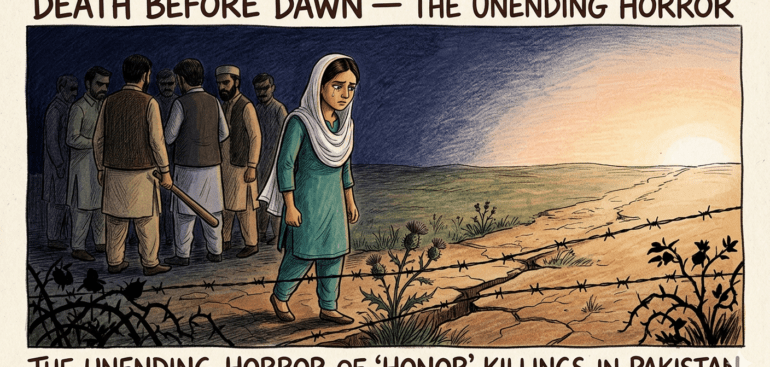
In the still darkness of Bhutto Chandio village, the life of a young woman was extinguished under the illusion of honor. It was just after 3:30 a.m. on April 10 when 19-year-old Khalida, known to some as Rubina, was shot dead, declared ‘Kari’ by her own relatives and executed before the eyes of villagers, and heartbreakingly, before the police.
According to the First Information Report (FIR) filed at Tando Masti Police Station, officers on patrol near Faiz Wah stop received a call that a woman was being assaulted. They arrived swiftly, but too late to save her. Standing in the dim light of a mobile phone, four armed men surrounded Khalida. Without mercy, one of them — Wali Muhammad Chandio — branded her a woman of “illicit character” and ordered her death. Three others raised their pistols and fired. She collapsed to the ground, a bullet piercing her chest, her young life stolen in the name of a false and deadly honor.
Even in the presence of law enforcement, the brutality continued unchallenged. The men fled into the night, leaving behind silence, smoke, and a shattered body that would speak more about this country’s moral wounds than any sermon could. Police later recovered spent shells from the scene and took the body to Civil Hospital Khairpur for a postmortem. The case has since been registered under Sections 302, 311, and 114 of the Pakistan Penal Code.
Two of the eleven accused — including key suspects Wali Muhammad and Qaisar Chandio — have been arrested. The District & Sessions Judge of Sukkur, Manoo Mal Khagaija, took suo motu notice after a chilling video of the killing went viral online. In that video, Khalida’s final moments became a public spectacle — a mirror reflecting our collective failure to protect women from the claws of patriarchal violence.
Khairpur SSP Captain (Retd.) Ameer Saud Ahmed Magsi called the murder a “crime against humanity.” Yet such crimes are not isolated — they are symptoms of a deeper societal rot. Each year, hundreds of women across Pakistan are murdered under the guise of “honor.” Behind every case lies the same pattern: whispering villagers, sham judgments, and silent onlookers. The law itself, though strengthened in recent years, still struggles against centuries of tradition that prioritize family ‘honor’ over human life.
Khalida’s parents insist their daughter was innocent — not a ‘Kari’ but a victim twice over: first of abduction, then of an honor killing masked as justice. They allege that local police demanded a bribe before registering the case, an accusation now under investigation. Their grief, raw and hollow, tells a story that has echoed for generations: of powerless parents watching powerful men destroy their daughters in the name of purity.
PPP MNA Nafeesa Shah condemned the killing, calling for swift punishment for all involved. But beyond condemnation, Pakistan now faces a moral reckoning. Laws alone cannot end honor killings if silence and complicity continue to protect the killers. The soul of a nation is tested not by its slogans of faith or progress, but by how it treats its most vulnerable.
Khalida’s blood stains more than one street in Khairpur — it stains the conscience of a society that keeps finding ways to justify murder with words like “honor.” Until justice stops bowing before tradition, until life is held sacred above reputation, the dawn will continue to arrive bearing the same unbearable news: another daughter, another death, another promise broken.