In Pakistan, the situation of the Ahmadiyya community is often described by human rights observers as one of the most restrictive religious frameworks in the modern world. At the centre of it lies something unusual and deeply consequential: laws that not only regulate behaviour, but also decide who is legally recognised as Muslim and who is not.
For many people, religion is a private and personal matter, tied to family, memory, belief, and identity. But for Ahmadis in Pakistan, that private space often becomes closely connected to the state, where belief is not only a matter of faith but also of legal definition and public consequence.
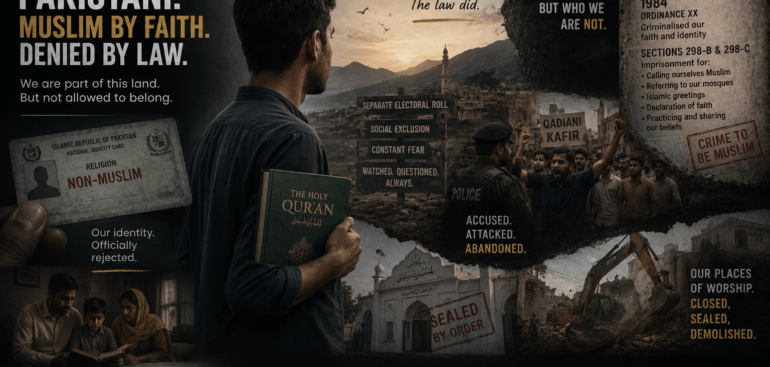
This situation began in 1974, when a constitutional amendment declared Ahmadis to be “non-Muslim” under Pakistani law. For a community that identifies itself as Muslim, this was not just a symbolic change but a fundamental shift in how they were officially seen by their own country. A decade later, during the military rule of General Zia-ul-Haq, the situation became even more restrictive with the introduction of Ordinance XX in 1984.
This law made it a criminal offence for Ahmadis to engage in ordinary religious expressions that most people would consider normal and harmless. From that point onward, everyday acts could carry legal risk, and simple expressions of faith could become matters for police or courts.
Under sections such as 298-B and 298-C of the Penal Code, Ahmadis can face imprisonment for actions that are deeply connected to religious life, including calling themselves Muslim, referring to their places of worship as mosques, using common Islamic greetings, reciting basic declarations of faith, or practising and sharing their interpretation of Islam.
What makes this legal framework particularly striking is not only what it restricts, but how specifically it targets one community. It does not broadly regulate religion in general terms; instead, it names a specific group and controls how that group is allowed to express its own beliefs. As a result, uncertainty becomes part of daily life, where actions that most people do without thought can require caution, restraint, or silence.
For Ahmadis in Pakistan, these laws are not distant legal texts but part of lived experience. They appear in moments that others might see as ordinary. Identity documents require them to declare themselves as non-Muslim. Electoral systems place them in separate categories. Social and religious spaces can become areas of scrutiny or tension. Even cemeteries and places of worship have, at times, been affected by restriction or interference. Over time, this creates something difficult to describe in legal language alone: a quiet but constant feeling of being watched, questioned, and placed at the edges of belonging in one’s own society.
The situation becomes even more complex when legal restrictions overlap with social hostility. In some cases, accusations or misunderstandings can lead not only to legal consequences but also to community pressure or violence. Even when formal legal action does not occur, fear can still shape behaviour—what is said, how openly one lives, and how safely one can express identity. This mixture of law and social environment deepens the sense of insecurity and makes everyday life unpredictable.
Because of this, many Ahmadis have left Pakistan over the years in search of safety and freedom to practice their faith without fear. Some leave for education or work, but for many, the deeper reason is the hope of living without the constant pressure of legal or social risk tied to identity itself. Those who leave often carry a quiet sense of loss—not only of place, but of community, memories, and a life that might have been. Those who remain often show resilience, but also live with awareness and caution in almost every aspect of daily life.
Outside Pakistan, asylum systems in countries such as the UK, Canada, and others have often recognised the risks faced by Ahmadis as serious and systemic. Their claims are assessed not only in terms of law but also in relation to social vulnerability and lived reality. Yet behind legal categories and case decisions are individual lives—people making difficult choices about safety, identity, and the possibility of a future where they can live without fear.
At its core, the situation of Ahmadis in Pakistan raises a deeply human question about belonging: what happens when a person’s understanding of their own faith does not match the identity assigned to them by law? For Ahmadis, this is not an abstract debate but everyday life, shaped by the right to speak their faith, practice it openly, and exist without fear of punishment for who they believe themselves to be. And perhaps the most difficult truth in this story is that when law begins to define identity too narrowly, belonging itself can stop feeling natural and instead become something that must constantly be negotiated, carefully managed, and quietly protected.