
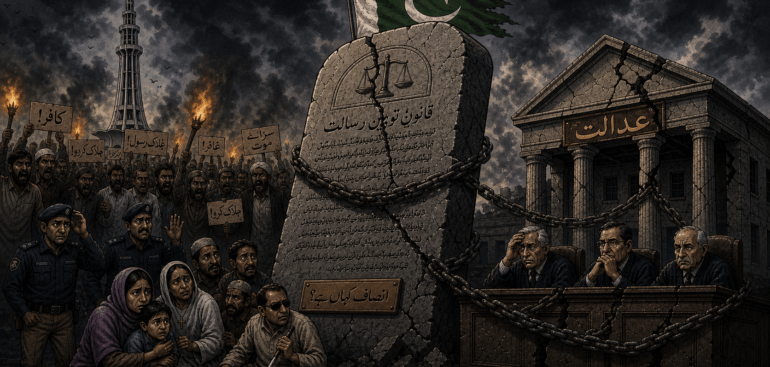
Pakistan’s blasphemy laws have become one of the country’s most controversial issues, not only because of their impact on religious minorities but also because of the repeated failure of institutions to prevent their misuse. A law that should operate within the boundaries of justice and fairness has, in many cases, become a source of fear, intimidation, and social unrest.
The biggest failure has been that Pakistan’s justice system has often struggled to protect the innocent from false accusations. The case of Rimsha Masih, a Christian girl with Down syndrome, exposed serious weaknesses in the system. She was accused of desecrating the Quran, but later evidence suggested that the accusations were fabricated. Although she was released, the damage had already been done. Her family faced immense pressure, and the incident highlighted how easily a person can become a victim before a court even examines the facts.
The judiciary and law enforcement agencies have repeatedly been criticized for failing to act strongly against those who misuse blasphemy allegations. When false accusers or those who manipulate religious emotions are not held accountable, it sends a dangerous message that such actions can continue without consequences. This lack of accountability weakens public trust in the legal system.
Many cases have shown that blasphemy accusations are sometimes linked to personal disputes, property conflicts, or attempts to silence opponents. The case of Nadeem Masih, a blind Christian man who was accused and later released, raised further questions about how easily vulnerable people can be targeted. When courts eventually clear such individuals, it often comes after they have already suffered social, financial, and emotional damage.
Pakistan’s failure is not only in preventing false accusations but also in controlling mob reactions and protecting citizens. Past incidents of violence against Christian communities, including attacks in Gojra, Joseph Colony, and other areas, revealed serious weaknesses in state protection. When crowds can threaten lives and destroy property based on allegations that have not been proven, it reflects a failure of law enforcement and governance.
The role of the judiciary is especially important in such cases because courts are supposed to be the final protection against injustice. However, delays, social pressure, and fear of controversy have often created an environment where justice becomes difficult to achieve. A strong judiciary should ensure that accusations are properly investigated and that innocent people are protected from punishment based on rumors or emotional reactions.
Another major concern is the perception that blasphemy laws are applied unevenly. Ordinary citizens, especially poor and minority communities, often face severe consequences, while influential figures accused of similar offenses may receive greater protection. This unequal treatment damages the credibility of Pakistan’s legal institutions and creates the impression that justice depends on a person’s power and connections.
The issue is not about ignoring religious sensitivities. Respect for religion is important in any society. However, a modern legal system must ensure that religious laws cannot be used as weapons for revenge, political pressure, or personal gain. Protecting faith should never come at the cost of denying justice to innocent people.
Pakistan’s challenge is therefore not only the existence of controversial laws but the failure of institutions to prevent their misuse. A justice system that cannot protect its most vulnerable citizens loses public confidence. Real reform requires stronger accountability, independent investigations, and a commitment from courts and authorities to uphold justice above pressure from powerful groups.
Until Pakistan’s institutions address these failures, blasphemy allegations will continue to remain a symbol of fear rather than justice, and the country will struggle to convince both its citizens and the world that the rule of law is truly being protected.