
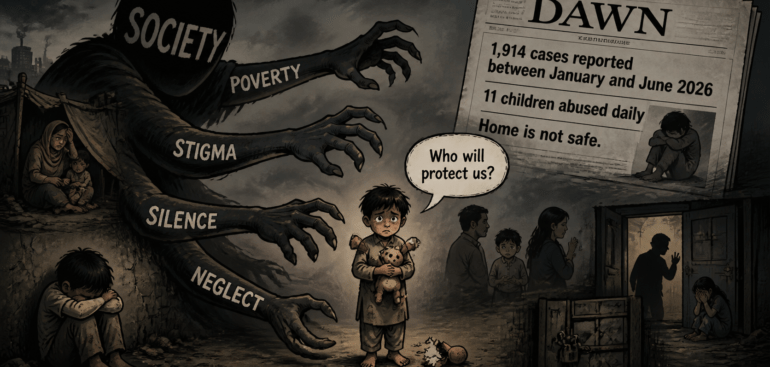
Nearly 1,914 cases of child abuse were reported across Pakistan between January and June 2026, according to Sahil’s latest Six Months Cruel Numbers report. Although the figure is slightly lower than the 1,956 cases recorded during the same period last year, it remains a disturbing measure of the dangers faced by children across the country.
On average, almost 11 children were reported as victims of abuse every day during the first six months of the year. These figures, however, reflect only incidents reported in newspapers. Many cases never reach the media or the police because of fear, social stigma, family pressure, poverty and limited access to justice. The actual scale of abuse is therefore likely to be considerably higher.
Sahil, a child-protection organisation that has worked in Pakistan since 1996, compiled the report by monitoring 81 English, Urdu and regional newspapers. Its review covered all four provinces, Islamabad Capital Territory, Azad Jammu and Kashmir, and Gilgit-Baltistan.
Abuse within the circle of trust
The report recorded 1,015 cases of child sexual abuse and 558 cases of abduction. It also documented 101 missing children, 35 child marriages, and 98 cases involving pornography linked to sexual abuse. In addition, 49 infants were reportedly found abandoned by roadsides.
Girls made up 58% of the reported victims, while boys accounted for 42%. However, boys represented 59% of the victims in cases involving pornography linked to sexual abuse, compared with 41% girls.
One of the report’s most disturbing findings is that the alleged abuser was known to the child or the family in 43% of cases. Strangers were involved in 34%, while the relationship was not identified in the remaining cases.
Acquaintances, relatives, fathers, uncles, neighbours and religious teachers were among those named in media reports. The findings challenge the assumption that children are mainly threatened by strangers. In many cases, the danger comes from within the child’s own circle of trust.
The home, often considered a place of safety, was the location of 45% of reported incidents. Another 18% occurred at the alleged abuser’s residence. These figures underline the urgent need for families, schools and communities to recognise warning signs and take children’s complaints seriously.
Adolescents among the most vulnerable
Children aged 11 to 15 accounted for the largest number of cases, with 598 incidents, or approximately 31% of the total. They were followed by children aged 16 to 18, with 356 cases, and those aged 6 to 10, with 329 cases. Ninety-five cases involved children aged five or below, while the ages of victims were not reported in 487 cases.
Abduction was the most frequently reported offence, accounting for 29% of cases. Rape and sodomy combined represented 28%, while missing children accounted for another 7%. Several incidents involved multiple offences, including abduction with rape, gang rape, incest and child marriage.
Punjab carries the heaviest burden
Punjab accounted for 80% of all reported cases, followed by Sindh with 15%. The remaining 5% were spread across Khyber Pakhtunkhwa, Balochistan, Islamabad, AJK and Gilgit-Baltistan.
Faisalabad recorded the highest number of cases, with 337, followed by Multan with 185 and Lahore with 121. Gujranwala, Kasur, Rahim Yar Khan, Rawalpindi, Vehari, Sialkot and Toba Tek Singh were also among the districts with the highest reported figures.
Urban areas accounted for 57% of cases, while 43% came from rural areas. This indicates that child abuse is a national crisis affecting communities across geographic and social boundaries.
A crisis demanding action
Sahil reported that 89% of the cases were formally registered with the police. However, seven cases remained unregistered, and police reportedly refused to register a complaint in one case.
Behind every figure is a child who has suffered fear, pain and the loss of safety. These are not simply numbers in a report; they represent lives damaged by abuse and families left to seek justice in an often inadequate system.
Pakistan needs stronger child-protection institutions, faster investigations, effective prosecution and accessible support for survivors. Police must be held accountable when complaints are ignored, while children must be protected from blame, shame and further trauma.
The small decline from last year should not be mistaken for meaningful progress. Until every child can live safely at home, in school and in the community, the country’s duty to protect its children remains unmet.