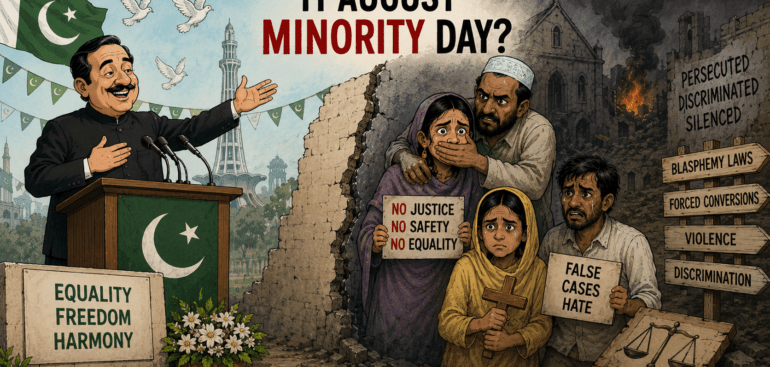
Every year on 11 August, Pakistan celebrates Minority Day. Government leaders deliver speeches about equality, religious freedom, and harmony. They remind the world of Muhammad Ali Jinnah’s promise that all citizens would enjoy equal rights regardless of their religion.
But for many religious minorities in Pakistan, Minority Day is not a celebration. It is a painful reminder of how far the country has failed to fulfill those promises.
In 2026, Christians, Hindus, Ahmadis, Sikhs, and other minority communities continue to face discrimination, violence, and injustice. While government officials speak of tolerance, minorities often live with fear. They face attacks on their places of worship, social exclusion, forced conversions, false blasphemy accusations, and a justice system that frequently fails to protect them.
One of the biggest problems is the misuse of Pakistan’s blasphemy laws. These laws have become a powerful weapon against vulnerable people, especially religious minorities. A simple accusation can destroy lives. Many innocent people have spent years in prison, faced violent mobs, or been forced into hiding. In many cases, courts take years to deliver justice, while the accused and their families suffer.
Forced conversions and child marriages continue to stain Pakistan’s human rights record. Every year, Christian and Hindu families report cases of young girls being abducted, converted, and married to older men. Although authorities often claim that these conversions are voluntary, many families say their daughters are pressured, threatened, or denied the chance to speak freely in court. Despite repeated promises from the government, this problem remains unresolved.
The situation of the Ahmadiyya community is even more alarming. Ahmadis are denied basic religious freedoms and are often targeted simply because of their faith. Laws specifically restrict how they practice their religion. Their mosques are attacked, their graves are desecrated, and many live under constant threat. Instead of protecting them, the state continues to enforce laws that contribute to their exclusion.
Minorities also face discrimination in everyday life. Many Christians remain trapped in low-paying sanitation jobs and are often treated as inferior because of their faith. Hindus in rural Sindh continue to report cases of land grabbing, intimidation, and forced conversions. Minority communities are underrepresented in politics, government institutions, and decision-making bodies.
The tragedy is not only the violence itself but also the lack of accountability. Time and again, those responsible for attacks on minorities escape punishment. Investigations move slowly, cases drag on in courts, and victims are left waiting for justice. This creates a dangerous message: minorities can be targeted, and the state may do little to stop it.
Pakistan often presents itself internationally as a country committed to religious freedom. Yet the reality on the ground tells a different story. Human rights organizations, international watchdogs, and foreign governments continue to raise concerns about the treatment of minorities. The gap between official promises and reality grows wider every year.
Minority Day should be a day to celebrate equality. Instead, it exposes the deep failures of the Pakistani state. Ceremonies, speeches, and social media messages cannot hide the suffering of those who continue to face discrimination and violence because of their faith.
Seventy-nine years after independence, Pakistan’s minorities are still waiting for the rights they were promised. Until the country confronts forced conversions, the misuse of blasphemy laws, anti-Ahmadi discrimination, and violence against religious minorities, Minority Day will remain less a celebration and more an annual reminder of broken promises.
For many minorities in Pakistan, 11 August is not a day of pride. It is a day that asks a difficult question: if all citizens are equal, why are minorities still struggling for basic justice, dignity, and security?