
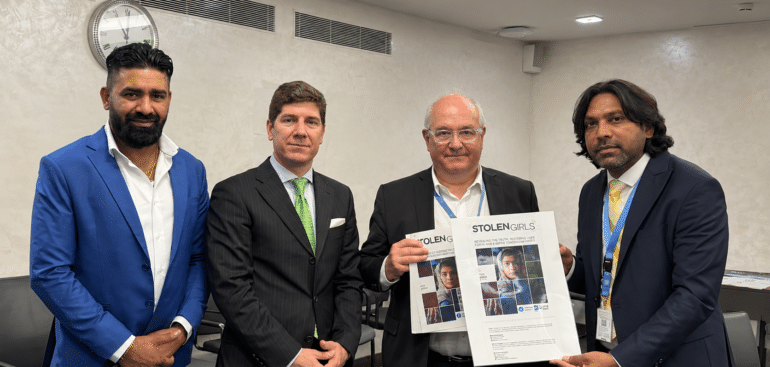
On October 1, 2026, three UN special rapporteurs delivered a stark warning to Pakistan at a Human Rights Council side‑event in Geneva: laws on paper mean nothing when courts, police and prosecutors look away. Their words came as families of abducted girls played video testimonies from dark rooms, begging for help that never arrives.
At the centre of this crisis stands Maria Shahbaz, a Christian girl taken in July 2025 at age 12–13 by 30‑year‑old Shehryar Ahmad, forced to convert to Islam and married against her will, then presented in court as an adult who “chose” both.
Her parents have gone from court to court. Police delayed filing reports. Judges accepted disputed documents. In February and March 2026, Pakistan’s Federal Constitutional Court upheld custody with her abductor, refusing even to confirm her age despite evidence she was a minor. In Geneva, her mother’s words cut through diplomatic language: “We don’t know where they are keeping her. We have terrible thoughts about what is happening to her.”
Professor Nicolas Levrat, UN special rapporteur on minority issues, said Pakistan is bound by the Convention on the Rights of the Child to protect children from forced conversion and child marriage, but warned that more laws will not fix what is broken: impunity thrives because police, prosecutors and judges fail to act, and institutional bias favours the dominant religious group.
Dr Katarina Schwarz, special rapporteur on contemporary forms of slavery, stressed that child marriage is exploitation and, in many cases, slavery; the state bears responsibility to prevent it and to protect victims—robustly and effectively.
Reem Alsalem, special rapporteur on violence against women, acknowledged Punjab’s Child Marriage Restraint Act 2026, which raised the marriage age to 18 and criminalized cohabitation with a child, yet noted that accountability still depends on which court hears a case, and that families face pressure—from perpetrators and sometimes law enforcement—to withdraw complaints.
Maria is not alone. Advocates at the event cited more than 210 documented cases of minor Christian girls abducted across Pakistan, with an average victim age of just 12.8 years; Punjab remains the epicentre. In April 2026, UN experts described these abuses as “systemic discrimination against non‑Muslim women and girls” and called for criminalizing forced conversion, raising the marriage age nationwide, and enforcing trafficking and sexual‑violence laws; Islamabad has not responded. Christophe Foltzenlogel of the European Center for Law and Justice asked why stolen property receives more care than stolen children. Joseph Janssen of Jubilee Campaign described how courts dismiss a child’s status once she is declared Muslim, treating apostasy fears as more urgent than abduction.
The message from Geneva was clear: Pakistan must rescue these girls now, place them in protective custody, and then pursue justice. Laws exist. Obligations exist. What is missing is the will to enforce them. Until the state treats the abduction of a girl with the same urgency as the theft of property, these crimes will continue—and the world will keep watching a nation betray its own children.