
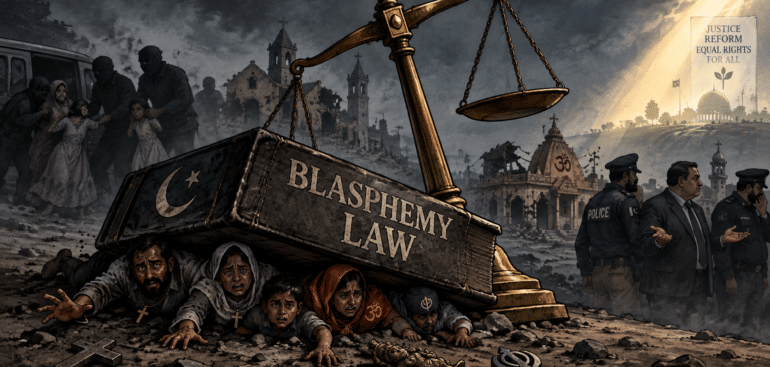
Pakistan’s religious minorities continued to face violence, discrimination and persecution in 2025, according to the National Commission for Justice and Peace (NCJP), a human rights body of the Pakistan Catholic Bishops’ Conference.
Its Human Rights Monitor 2026 presents a deeply troubling picture. Christians were targeted by blasphemy accusations, while minority women and girls remained vulnerable to abduction, forced conversion and forced marriage. These are not isolated incidents. Together, they reveal a system in which vulnerable citizens are often denied equal protection under the law.
The NCJP recorded eight Christians accused of blasphemy during the year. Two obtained bail, while eight others were acquitted. The cases demonstrate how blasphemy laws can destroy lives even when courts ultimately find the evidence inadequate.
One of the clearest examples is Anwar Kenneth, a 72-year-old Christian acquitted by the Supreme Court in June 2025 after spending 23 years on death row. Christian nurses Mariam Lal and Newosh Arooj were also acquitted in November after a court found that the allegations against them had not been properly proven.
Yet acquittal cannot restore lost decades, damaged reputations or shattered families. The NCJP has therefore called for the repeal or substantial amendment of blasphemy laws, compensation for victims and a comprehensive study of their social, economic and psychological impact.
The report also recorded deadly violence. Kashif Masih, a Christian labourer from Sialkot, was allegedly tortured to death after being accused of stealing a mobile phone. Police initially failed to register the incident as murder, prompting protests from the Christian community. In September, Afzal Masih was shot dead while travelling with Christian pilgrims after reportedly confronting men who had harassed female passengers.
Minority women and girls faced another form of injustice. The NCJP documented 35 incidents affecting women, girls and families. One case involved 15-year-old Hindu girl Premi Bheel, who was reportedly abducted, forcibly converted and married in December. Local police allegedly refused to register her complaint.
Accountability also remains painfully weak. Two years after the 2023 attacks in Jaranwala, where more than 25 churches and 85 Christian homes were damaged, the perpetrators had still not been convicted, according to the report.
There were some positive developments. The Islamabad High Court banned the discriminatory phrase “Christians only” in sanitation job advertisements, and the National Commission for Minorities Rights Act 2025 created a statutory body to monitor minority protections.
But legislation alone will not end persecution. Pakistan must enforce equal citizenship, protect places of worship, prosecute attackers and defend minority women and children. A country cannot claim religious heritage while allowing part of its population to live in fear.
The NCJP’s warning is clear: minorities will remain invisible unless the state treats their rights as a constitutional duty, not a matter of political choice.