
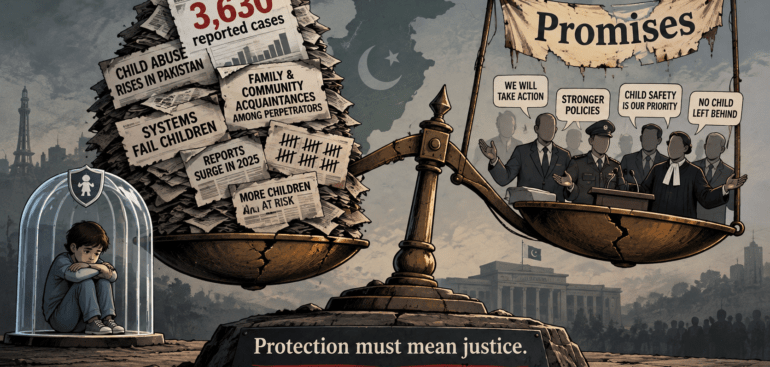
Pakistan recorded 3,630 reported child abuse cases in 2025, according to figures released by Sahil, an organisation that monitors violence against children and women. The cases appeared in 81 newspapers across the country, including reports from all four provinces, Islamabad Capital Territory, Azad Jammu and Kashmir, and Gilgit-Baltistan.
The figure represents an 8% increase from 2024, with 266 more cases recorded. It means that more than nine children faced abuse every day on average. Behind these numbers are children whose safety failed them, families forced to seek justice, and communities that must confront a crisis they can no longer ignore.
Girls accounted for 1,924 cases, or 53% of the total, while boys accounted for 1,625 cases, or 47%. The report also recorded 116 cases involving newborn babies. Children aged between 11 and 15 emerged as the most vulnerable group, with boys outnumbering girls in that age category.
Abduction remained the most commonly reported form of abuse, with 1,107 cases. The data also included 596 cases of sodomy, 522 rapes, 365 missing children, 195 attempted rapes and 141 attempted sodomy cases. Authorities also recorded gang sodomy, gang rape, murder after sexual abuse and child marriage.
These figures reveal the disturbing range of dangers confronting children. They also challenge the belief that abuse usually comes from unknown criminals. Sahil reported that acquaintances remained the most common perpetrators in child sexual abuse cases. This reality makes protection more difficult because children often face danger from people they know and may trust.
Punjab accounted for 73% of all reported child abuse cases, followed by Sindh with 21% and Khyber-Pakhtunkhwa with 4%. Balochistan, the federal areas, AJK and Gilgit-Baltistan together accounted for the remaining 2%. However, these figures do not necessarily reflect the true scale of the crisis. Many cases may never reach the police, courts or newspapers because of fear, stigma, pressure from relatives and a lack of confidence in the justice system.
Sahil said police registered 82% of the reported cases, describing this as a positive sign of active policing. Registration, however, must lead to investigation, prosecution and justice. A case number alone cannot protect a child or prevent another crime.
The organisation also reported 7,071 cases of gender-based violence in 2025, a 34% increase over the previous year. Murder was the largest category, with 1,546 cases, followed by abduction, torture, rape, suicide, injury, harassment, honour killings and acid attacks.
Punjab represented 78% of the reported GBV cases, while Sindh accounted for 14% and Khyber-Pakhtunkhwa for 6%. Acquaintances made up 32% of alleged abusers, strangers 18% and husbands 12%.
Every annual report brings another set of figures, another wave of outrage and another cycle of promises—then people move on while children stay at risk. The real question isn’t just how many cases were reported, but how many were hidden, ignored or never spoken about; how many survivors were blamed or told to stay quiet; and how many abusers walked free because of power or connections.
These numbers must not become just another statistic. Pakistan needs stronger child protection, faster investigations, real support for survivors and real accountability. Most of all, abuse cannot be treated as a private family matter. Every child deserves safety, dignity and justice—and every failure to protect them costs lives