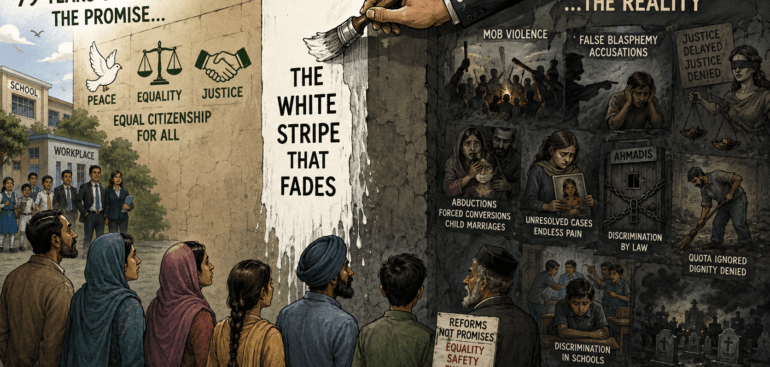
Pakistan marks 79 years of independence this August 14, 2026. The national flag flies high—green for the Muslim majority, and a white vertical stripe at the hoist for religious minorities. That white band stands for peace, honesty, and the promise of equal citizenship. Yet for millions of Christians, Hindus, Sikhs, Ahmadis, and others, the white stripe feels like a symbol that does not match their daily reality.
A Promise Unkept
On August 11, 1947, Muhammad Ali Jinnah told the Constituent Assembly that faith would not decide a citizen’s rights. Pakistan now observes that date as National Minorities Day. But activists say the state’s “lip service” has not stopped discrimination, blasphemy accusations, forced conversions, and mob violence.
Everyday Fear and Injustice
Minority families live under constant threat. Blasphemy allegations—often filed to settle personal scores—can trigger mobs, extrajudicial killings, and years of legal limbo. Communities still await justice for the Jaranwala tragedy, while cases like Maria Shahbaz’s court-validated child marriage and conversion, and the unresolved disappearance of Priya Kumari, deepen the sense of abandonment.
Women and girls face layered danger. Abductions, forced conversions, and underage marriages target minority communities, with law enforcement slow to act and perpetrators rarely held accountable.
Work, School, and the Walls of Exclusion
Discrimination follows minorities into schools and workplaces. Children report bias from classmates and teachers, curricula that reinforce stereotypes, and pressure to join religious activities that contradict their beliefs. The result is isolation, lower achievement, and dropouts.
In employment, the 5 percent quota for minorities in federal and provincial jobs remains poorly enforced. Tens of thousands of reserved posts sit vacant, and those hired are often pushed into low-grade sanitation roles regardless of qualifications.
The Ahmadi Question
Ahmadis face the harshest legal barriers. Laws bar them from identifying as Muslims and restrict their religious practices, entrenching their exclusion from public life and making them targets of organized persecution.
The Flag’s White Centre
Pakistan’s flag is explicit: the white stripe represents religious minorities and their protection. Yet the lived experience—fear, exclusion, and impunity for attackers—belies that design. As advocates put it, Jinnah’s vision cannot be fulfilled without equal citizenship in practice, not just on paper.
What Must Change
Rights groups demand concrete steps: remove discriminatory constitutional clauses, enforce the job quota transparently, protect minority women and children, and end the misuse of blasphemy laws. They call for real reforms that guarantee equality, safety, dignity, and justice for all citizens.
At 79, Pakistan’s independence is a moment to ask hard questions. If the white stripe means minorities belong, then their security, representation, and dignity must be non-negotiable. Otherwise, the flag’s promise remains a color that fades in the sun.