
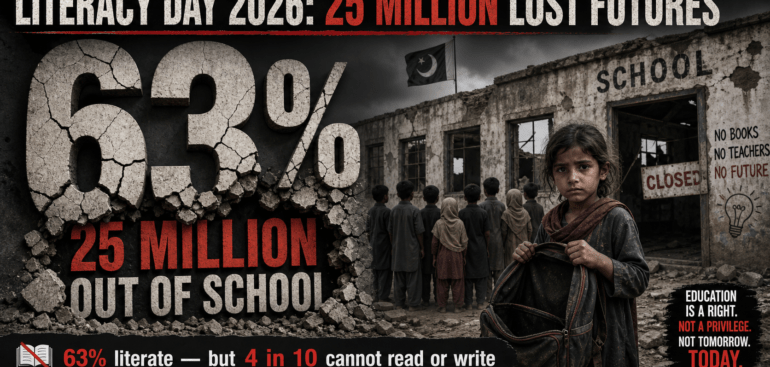
International Literacy Day should be a day of hope. Instead, in Pakistan, it is also a reminder of a national failure.
While speeches praise education and officials celebrate small improvements, millions of children remain outside classrooms. They do not carry schoolbags. They do not sit at desks. Many work in fields, factories, workshops, homes and streets. Many girls stay home because their families cannot afford school, because schools are too far away, or because society still does not treat their education as a priority.
According to UNICEF, Pakistan has an estimated 25.1 million children aged 5–16 out of school. That is not just a troubling figure. It is a crisis on a massive scale. It means millions of young lives are being denied the basic right to learn, dream and choose a better future.
The Pakistan Economic Survey 2025–26 reports that the literacy rate for people aged 10 and above is 63%, based on 2024–25 data. The number may sound like progress, but it also means that nearly four out of every ten people in this age group cannot read and write properly. Pakistan cannot call this a success when such a large part of its population remains locked out of knowledge and opportunity.
The gap hurts girls the most. About 31% of girls aged 5–16 are out of school, compared with 25% of boys, according to the figures provided. For too many girls, education ends before it has truly begun. Poverty, early marriage, household work, insecurity and social pressure push them out of classrooms. When a girl loses access to education, the country loses a future teacher, doctor, entrepreneur, leader or skilled worker.
The crisis also has a sharp provincial face. Punjab has the largest number of out-of-school children, estimated at 9.7 million. Sindh has 7.4 million and Khyber Pakhtunkhwa has 4.5 million. In Balochistan, an estimated 69% of children aged 5–16 are out of school—the highest share among the provinces. This is not simply an education problem. It reflects deep inequality, weak public services and years of neglect.
Pakistan must stop treating education as a promise for the future while failing children in the present. Announcing new targets is not enough. Enrolling children for a few months is not enough. A school without teachers, books, toilets, electricity, safety or transport cannot protect a child’s right to education.
The country needs urgent action: more public investment, functioning schools in rural and poor communities, trained teachers, safe transport for girls and support for families who depend on child labour to survive. Leaders must also ensure that children learn—not merely appear in enrolment records.
A country cannot build a strong economy, stable democracy or fair society while millions of its children remain invisible to the education system.
On 8th September, Pakistan should not only celebrate literacy. It should ask a harder question: how many more children must lose their future before education becomes a real national priority?