
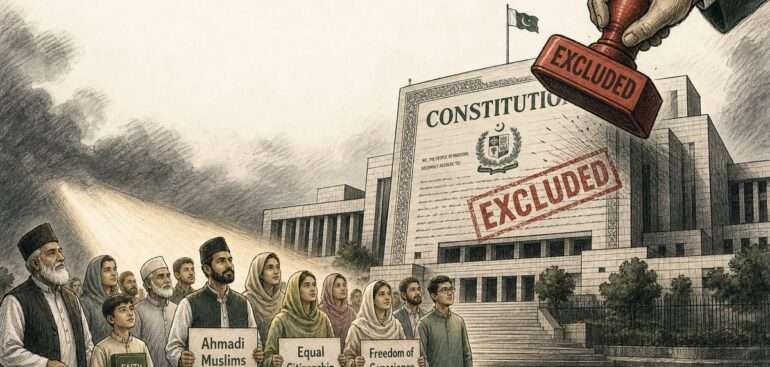
7 September 1974 remains one of the darkest days in Pakistan’s constitutional history. On this day, Parliament, led by Prime Minister Zulfikar Ali Bhutto, passed the Second Amendment and declared Ahmadis non-Muslims “for the purposes of the Constitution or law.” The state made a decision it should never have had the right to make: it decided the religious identity of its own citizens.
Pakistan was created after Muslims in British India struggled for political rights, safety, and dignity. That struggle was meant to protect people from discrimination—not create new forms of it. Muhammad Ali Jinnah spoke of a Pakistan where religion would remain a personal matter and where the state would treat every citizen equally. But only 27 years after independence, Pakistan’s leaders moved away from that promise.
The Second Amendment was not simply a change in words. It officially separated Ahmadi Muslims from the wider Muslim community and told them that their own understanding of their faith had no value in the eyes of the state. Instead of protecting citizens from prejudice, the Constitution became a tool for exclusion.
The damage did not end in 1974. The amendment encouraged further laws that punish Ahmadi Muslims for calling themselves Muslim, using Islamic terms, practising their faith openly, or sharing their beliefs. These laws can lead to prison and fines. Over time, legal discrimination has also fed social hatred, threats, harassment, and violence.
That is why 7 September should not be remembered as just another date in Pakistan’s history. It was the day the state gave official power to religious prejudice. It showed that even elected leaders can sacrifice justice when they choose political pressure over principle.
Fifty-two years later, this is not only an Ahmadi issue. It is an issue of equal citizenship for every Pakistani. If the state can deny one community the right to define its own faith, then no minority can feel completely safe. When discrimination enters the law, it weakens justice, damages society, and makes the country less secure for everyone.
Pakistan cannot build a strong and peaceful future by excluding its own people. It must honestly face the legacy of 7 September 1974. Religious freedom is not a favour from the majority; it is a basic right. Ahmadi Muslims continue to seek equality, safety, and the freedom to live according to their conscience. Their struggle remains part of Pakistan’s unfinished struggle to become the fair and inclusive country it promised to be.