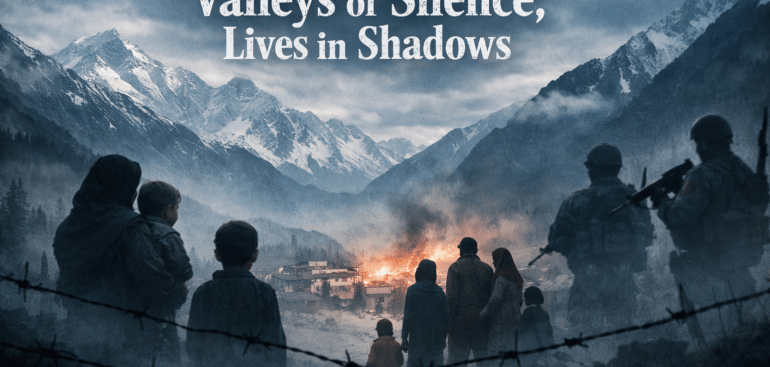
In the serene valleys of Gilgit-Baltistan, where snow-capped peaks meet flowing rivers, a tragic reality has persisted for over seven decades—one that remains largely invisible to the world. The Shia communities here, once the majority, live under the shadow of fear, oppression, and systematic violence orchestrated by the Pakistani military and its intelligence apparatus. This is not a sectarian conflict born of local animosity, as many outsiders assume. Rather, it is a deliberate strategy of control and exploitation, a mechanism of terror designed to consolidate power and extract strategic and financial leverage.
Since the military conquest of Gilgit-Baltistan in 1947, Shias have been deliberately targeted. The first Shia-Sunni clashes were staged by the army to portray local Shias as a threat, thereby garnering the support of the Sunni minority and solidifying military authority. Over the past 78 years, hundreds of Shias have been killed or displaced, their homes and livelihoods destroyed, all to serve the strategic goals of a distant military elite.
The attacks are not random. They are calculated, premeditated, and political. On March 1, 2026, another brutal chapter unfolded. Fourteen lives were brutally taken, including eight children under fifteen, and more than sixty civilians were injured during peaceful protests. These protests were a response to the assassination of Iran’s Ayatollah Khamenei, yet the military blamed the victims for violence, accusing them of arson and destruction. Eyewitnesses tell a different story: masked men initiated the shooting, creating a pretext for security forces to open fire on innocent civilians. Women were killed in front of onlookers. Children were gunned down. The message was clear—Shias here are expendable, tools in a larger game of geopolitical signaling.
Life in Gilgit-Baltistan has become unbearable. Ramadan, a sacred time of fasting and reflection, is overshadowed by scarcity, curfews, and constant surveillance. Access to water, electricity, and fuel is severely restricted, while food prices skyrocket. Ordinary acts of worship and daily survival have become acts of resistance.
The military has expanded its control through proxy religious leaders, surveillance, and legal manipulations, including the illegal establishment of military courts in a territory that is not formally part of Pakistan. These courts are used to criminalize dissent, target activists, and suppress any voices that challenge the army’s control, such as Shabbir Mayar, a leader opposing land theft and mineral exploitation, who remains under house arrest despite severe health concerns.
The Shias of Gilgit-Baltistan are also witnessing the systematic plundering of their land. Foreign corporations, awarded lucrative contracts by the military, extract copper, gold, uranium, and precious stones from ancestral lands, often with the support of local collaborators. The loss is not just economic; it is the erasure of heritage, identity, and the right to self-determination.
Despite the terror, the Shia community continues to resist. Their protests, their demands for justice, and their refusal to be silenced are a testament to human courage and resilience. But the price of resistance is steep—lives lost, children orphaned, communities traumatized. Every act of defiance is met with bullets, beatings, and incarceration.
The world must see the human face behind the statistics. Each death, each arrest, each burned home is a story of loss, fear, and despair. Gilgit-Baltistan is not just a contested territory—it is home to real people whose voices are muffled by guns and bureaucracy. Their suffering is a moral indictment of a military system that prioritizes strategic posturing over human life.
For peace to return, the Shia people of Gilgit-Baltistan must be recognized not as pawns in geopolitical games, but as human beings deserving of dignity, safety, and the right to self-determination. Until the guns are silenced, the curfews lifted, and the plunder of land and resources stopped, the valleys will continue to echo not with the laughter of children but with the cries of the oppressed.