
Pakistan’s crisis of violence against women is often reduced to numbers—but behind every statistic is a life interrupted, a voice silenced, and a story that never received justice. The data is important, but it does not fully capture the fear, the grief, and the quiet suffering that define this reality.
Still, the numbers are impossible to ignore.
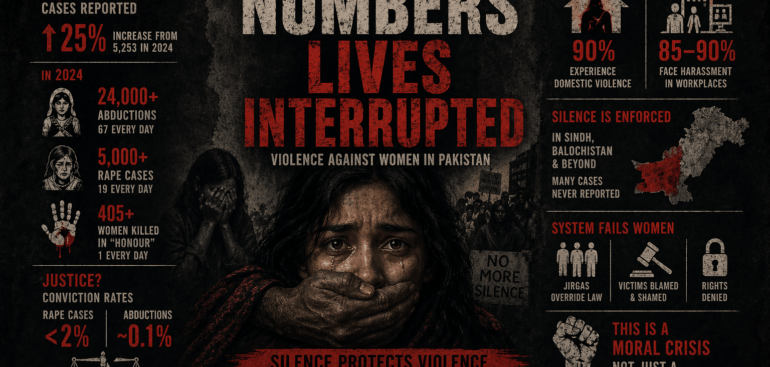
In 2025, 6,543 cases of gender-based violence were reported, rising sharply from 5,253 in 2024—a 25% increase in just one year. This is not just a trend; it is a warning. It signals that despite laws, policies, and public discourse, women across the country are becoming more vulnerable, not less.
The figures from 2024 are equally disturbing. Over 24,000 abductions—that is 67 women taken every single day. More than 5,000 rape cases, averaging 19 daily. And at least 405 women were killed in the name of “honour.” Each number represents a moment where someone’s world collapsed, often in silence.
But perhaps the most painful reality lies not in the crimes themselves, but in what follows—or rather, what does not. Justice remains rare. Conviction rates are shockingly low: less than 2% for rape cases and around 0.1% for abductions. These are not just failures of the legal system; they are signals sent to victims that their pain may never be acknowledged, and to perpetrators that they may never be held accountable.
Beyond reported cases, everyday life tells its own story. An estimated 90% of women experience domestic violence, while 85–90% face harassment in workplaces. This means that for many women, danger is not an exception—it is routine. It exists in homes, on streets, and even in institutions meant to provide safety and opportunity.
In regions like Sindh and Balochistan, the reality is often even harsher. Many cases never make it to official records, buried under social pressure, fear, or the influence of powerful local figures. There, silence is not just imposed—it is enforced.
What makes this crisis even more difficult to confront is how normalized it has become. Stories of women killed over personal choices, family disputes, or so-called honour appear with alarming regularity. They fade quickly from public attention, replaced by the next headline, the next tragedy. In this cycle, outrage is brief, but loss is permanent.
At the heart of the problem lies a system that has yet to fully recognize women as equal citizens. Informal mechanisms like jirgas continue to operate, often overriding formal law and delivering decisions that strip women of their basic rights. These parallel systems do not just fail women—they actively endanger them.
This is not simply a legal issue. It is a moral one. A society cannot claim progress while half its population lives under the constant threat of violence. It cannot call itself just when victims are left without recourse, and perpetrators walk free.
And yet, there is a quiet resilience. Women across the country continue to speak out, to demand accountability, to refuse silence despite the risks. Their courage stands in stark contrast to the indifference of the systems meant to protect them.
The statistics tell us how widespread the crisis is. The stories remind us why it matters.
Until both are taken seriously—until numbers lead to action and empathy leads to change—this cycle will continue. And more lives will be reduced to statistics when they deserved so much more.