In many parts of Pakistan, faith is something Christians carry quietly—sometimes in prayer, sometimes in fear.
They are a small community in a country of nearly 250 million people. According to recent findings from the World Watch List 2026country dossier, about 4.7 million Christians live in Pakistan, making up less than two percent of the population. On paper, the Constitution promises religious freedom. In reality, the distance between the law and daily life can feel painfully wide.
For many Christian families, faith is not just a spiritual identity. It is a social label that shapes where they live, the jobs they are offered, and how safe they feel in their own neighborhoods.
Born Into the Margins
A large portion of Pakistan’s Christian population traces its roots to communities historically labeled as “untouchable” during the subcontinent’s colonial and caste-driven past. Generations later, that stigma has not entirely faded.
Many Christians still find themselves pushed toward low-status work—cleaning streets, working sanitation jobs, or laboring in brick kilns under difficult conditions. The report notes that poverty within Christian communities is widespread, and in rural areas, some families remain trapped in bonded labor systems, where debts can tie workers to employers for years.
Behind the statistics are ordinary lives shaped by limited choices: fathers who work long hours in kilns under the burning sun, mothers who struggle to send their children to school, and young people who grow up believing that certain doors will always remain closed to them.
It is not just economic hardship—it is a quiet, persistent reminder that they sit near the bottom of society’s ladder.
When the Law Becomes a Threat
Perhaps the most sensitive issue surrounding religious minorities in Pakistan is the country’s blasphemy laws. These laws carry severe penalties and are meant to protect religious sentiments. But according to the report, they are frequently misused, particularly against minorities like Christians.
An accusation—sometimes based on rumor, misunderstanding, or even personal disputes—can spiral quickly. Even before courts step in, public anger can ignite.
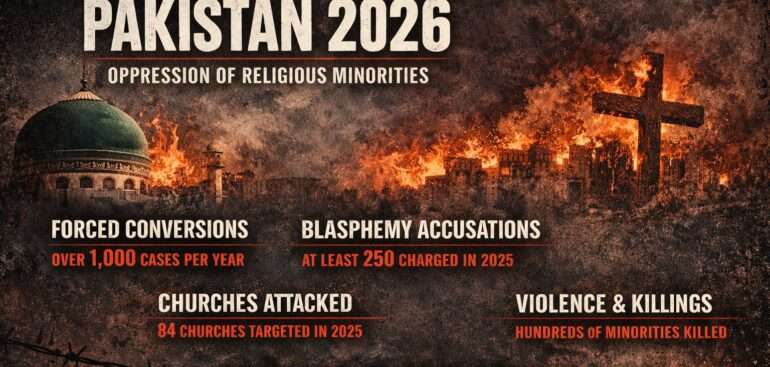
The violent attacks in Jaranwala in 2023, where churches were vandalized and Christian homes burned following blasphemy allegations, remain a painful memory for the community. For many Christians, what hurt almost as much as the violence itself was the sense that justice moved slowly—if at all.
The message that lingered in Christian neighborhoods across the country was unsettling: sometimes a single accusation can shatter entire communities.
The Fear Families Don’t Speak About
Within this fragile environment, Christian girls often face the greatest risks.
Human rights groups have documented cases where young girls are abducted, pressured to convert, and forced into marriage. While Pakistan has taken some legislative steps—such as raising the legal marriage age to 18 in the Islamabad Capital Territory—critics say enforcement remains inconsistent and many vulnerable families receive little protection.
For parents in struggling Christian communities, the fear is constant but rarely spoken aloud. Sending a daughter to school, to work, or even to the market can sometimes feel like stepping into uncertainty.
Politics and the Silence Around Minorities
Pakistan’s political system—shaped by shifting civilian governments, military influence, and rising religious populism—has not always prioritized minority rights.
Under the leadership of Prime Minister Shehbaz Sharif, Christians technically retain constitutional protections. Yet the report suggests that weak governance, local power dynamics, and pressure from hardline groups often prevent those protections from translating into meaningful security.
Politicians rarely ignore religious sentiment in Pakistan’s charged political climate. As a result, even discussing reforms to controversial laws can provoke intense backlash. For minorities, that political hesitation often feels like abandonment.
A Community That Refuses to Disappear
And yet, despite all this, Pakistan’s Christian community continues to endure.
Church bells still ring on Sunday mornings. Christian-run schools educate thousands of students from all religious backgrounds. Families celebrate weddings, baptisms, and holidays with quiet determination.
Many Christians say they are not asking for special treatment. They simply want what any citizen would want: dignity, safety, and the chance for their children to live without fear.
Pakistan is their home too.
But the report’s findings leave a difficult question hanging in the air: Can a nation truly promise religious freedom if an entire community still feels it must live cautiously in the shadows?
For millions of Christians in Pakistan, faith remains strong—but so does the hope that one day, belief will no longer come with a cost.