
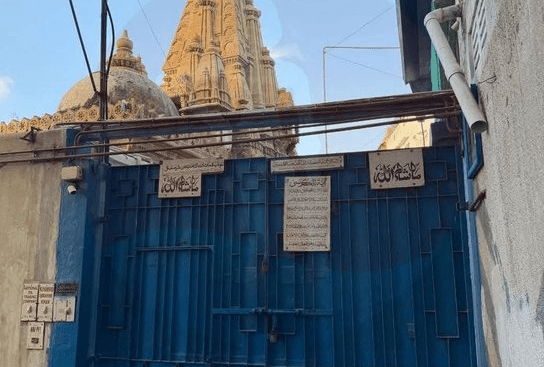
The heart of Karachi beats with centuries of history. Yet, one of its oldest spiritual symbols—the Ramchandra Mandir—now stands suffocated behind cold cement walls and iron gates adorned with Islamic inscriptions. On Ratan Talao Street, just steps from the Preedy Police Station, a place once resonating with prayer and coexistence has been buried under the weight of indifference and quiet encroachment.
For decades, the Ramchandra Mandir stood as a reminder of Karachi’s plural past—a time when Ram Talao’s waters reflected the diverse faiths of those who lived harmoniously beside them. Today, all that remains is a dome barely visible behind blank walls. The new barriers are more than mere construction; they are symbols of erasure, sealing off a sacred piece of history from the public gaze.
What makes this tragedy harder to digest is the silence of those responsible. The Evacuee Trust Property Board, entrusted with safeguarding such abandoned religious properties, has once again turned a blind eye. The Ministry of Religious Affairs and Interfaith Harmony—names that should inspire trust and fairness—remains detached, watching a piece of national heritage slowly disappear. How can a temple vanish beside a police station without a whisper of accountability? Is this not an indictment of institutional failure?
The irony cuts deep. Pakistan, a nation that emerged on promises of justice and minority protection, continues to betray those ideals when heritage sites belonging to non-Muslim communities are systematically neglected or quietly transformed. Each demolished shrine, each wall raised around a temple, chips away not just at the physical structure but at the moral foundations of a country that once promised equality to all its citizens.
Karachi’s skyline once shimmered with domes from temples, spires from churches, and the elegant minarets of mosques. This harmonious collage symbolized the city’s soul. Yet, today, that soul is being partitioned again—not by borders, but by apathy. The Ramchandra Mandir’s fading presence is not merely a local loss; it is a national shame—a monument to negligence disguised as progress.
If Pakistan truly seeks global respect and internal harmony, it must start by defending the forgotten corners of its own history. Protecting a temple does not threaten faith—it preserves humanity. To hide the Ramchandra Mandir behind cement and steel is to hide the truth of what Pakistan once was and what it still can be, if only it chooses remembrance over repression.