
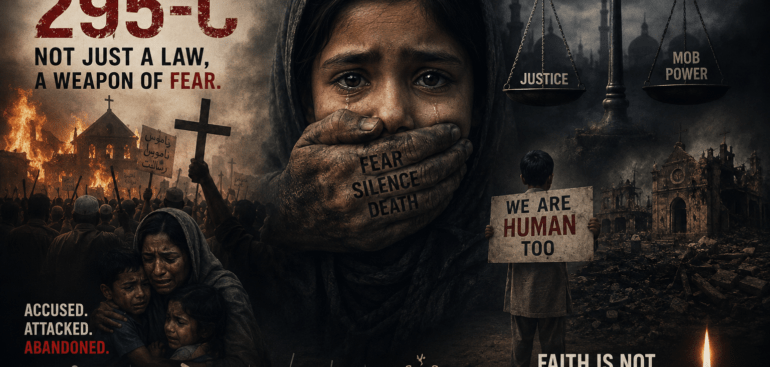
Pakistan’s blasphemy law, especially Section 295-C, is no longer just a law written in books. For many people, it has become a weapon of fear, silence, and death. What was once presented as a way to protect religious sentiments has, over the years, turned into one of the darkest tools of injustice in the country’s history.
The words of the law themselves are terrifying. Anyone accused of insulting Prophet Muhammad — through speech, writing, pictures, or even indirect expression — can face the death penalty. But the real tragedy begins long before any court announces a verdict. In Pakistan, an accusation alone is often enough to destroy a person’s life.
The most painful reality is that the accused rarely gets a fair chance to defend themselves. The moment an allegation is made, crowds gather, mosques echo with emotional calls to “protect the honour of the Prophet,” and angry mobs take the law into their own hands. Fear spreads faster than truth, and rage becomes more powerful than justice.
Again and again, the victims are poor people, powerless citizens, and religious minorities — especially Christians.
The ashes of Jaranwala still tell a heartbreaking story. In 2023, after allegations of Quran desecration against two Christian men, thousands of angry men stormed Christian neighborhoods. Homes were burned. Churches were destroyed. Families ran for their lives, carrying children in their arms. Elderly people watched decades of hard work disappear in flames within minutes. The accused had not even been proven guilty, yet an entire community was punished.
The same cruelty was seen in Joseph Colony in Lahore in 2013. One accusation against a Christian man was enough to turn a crowd into a violent mob. Homes were reduced to ashes while terrified women and children hid for safety.
Before that came Gojra in 2009, where innocent Christians were burned alive over false allegations linked to a wedding ceremony. A seven-year-old child named Musa died in the flames. Imagine that for a moment — a child losing his life not because of any crime he committed, but because adults were consumed by hatred and religious frenzy.
Then there was Shanti Nagar in 1997, where an entire Christian village was attacked. Hundreds of homes and churches were burned while the state stood helpless — or silent.
The pattern is always the same: accusation, outrage, violence, destruction, and then silence.
And perhaps the most frightening part is this: the attackers are rarely punished.
This sends a dangerous message throughout society — that violence committed in the name of religion is acceptable. It tells mobs that they are above the law. It tells minorities that their lives do not matter equally. And it tells ordinary citizens that one false accusation can destroy everything.
The murder of Punjab Governor Salman Taseer exposed this reality before the world. His “crime” was simply speaking against the misuse of the blasphemy law and supporting Asia Bibi. For this, he was murdered by his own bodyguard, Mumtaz Qadri.
But even more disturbing was the public reaction afterward. Qadri was celebrated like a hero by thousands. Lawyers showered him with rose petals. Massive crowds attended his funeral. It revealed a painful truth: extremism in Pakistan is not limited to a few violent groups; it has deeply entered public thinking and social attitudes.
For decades, human rights activists have tried to reform this law, but very little has changed. One major reason is that the debate has remained limited to courts, activists, and educated circles, while ordinary Pakistanis often think very differently. Many Muslims in Pakistan do not see the blasphemy law as a human law that can be debated or changed. They see it as a sacred part of their religion and believe that defending it means defending Islam itself. Because of this, anyone who speaks against the law is quickly labelled — and sometimes attacked — as an enemy of Islam.
This is why reform has become almost impossible. Politicians stay silent because they fear assassination. Judges fear public anger. Journalists fear being targeted. Even educated people avoid discussing the issue openly because a single sentence can cost them their careers, homes, or even their lives.
Pakistan today lives under the shadow of fear created by this law. But the tragedy is not only legal — it is deeply human.
Christian families teach their children to stay quiet and avoid arguments. Religious minorities live with constant anxiety. A simple misunderstanding, a personal dispute, or even jealousy can suddenly turn into a blasphemy accusation. In many cases, people misuse the law to settle personal scores, seize property, or take revenge.
And once accused, a person’s life is effectively over — even if they are later proven innocent. This is not justice. It is a collective fear disguised as religious honour.
No religion should become a reason to burn homes, kill innocent people, or silence the truth. No society can survive when mobs become more powerful than courts. A law that creates fear instead of justice slowly destroys the moral foundation of the nation itself.
Pakistan desperately needs courage — not the courage to kill in the name of faith, but the courage to defend humanity even when it is unpopular. The country needs voices brave enough to speak honestly about how religion is being misused to justify violence and hatred.
The real test of faith is not how loudly people demand punishment. The real test is whether they can show mercy, justice, and humanity.
Until that happens, Section 295-C will continue to haunt Pakistan — not as a symbol of religious respect, but as a painful reminder of how easily mob violence, fear, and religious extremism can silence justice and humanity.