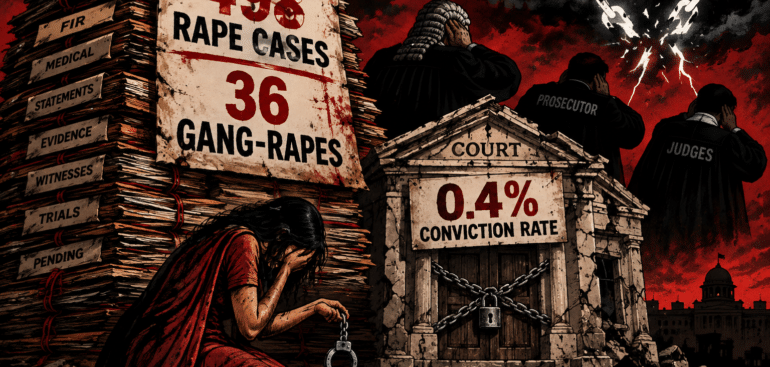
Lahore is bleeding in silence. In just eight months of 2026, police records show 498 reported rape cases and 36 gang-rape cases—more than four reported sexual offences every single day. These are not abstract numbers. They are daughters, sisters, mothers, and neighbours whose lives have been shattered, often inside the very homes meant to protect them.
The police-division breakdown reads like a map of trauma. Saddar leads with 132 reported rape cases, followed by Model Town with 98, Cantonment with 92, Iqbal Town with 80, City with 56, and Civil Lines with 40. Gang-rape cases are scattered across all six divisions: Model Town reported 10, Cantonment 9, and Saddar and Iqbal Town 6 each. No neighbourhood is spared. No community is immune. When sodomy cases are included, the total reaches 1,108 reported sexual-offence cases in eight months. This is not a crime wave confined to dark alleys or marginalised areas. It is happening in affluent sectors, crowded markets, and quiet residential streets. The violence is everywhere, and the fear is everywhere with it.
Here is the cruel truth: these statistics are not the full story. Rights organisations have long warned that registered FIRs represent only a fraction of actual offences. Stigma, shame, family pressure, distrust of police, and the threat of social ostracisation keep countless victims silent. Many never report. Many are told to stay quiet. Many are blamed. An increase in registered cases can signal two things at once: more crimes committed, and more courage to speak. But even with greater reporting, the system fails those who come forward.
Punjab’s rape conviction rate stood at approximately 0.4% in 2024—a figure so low it mocks the very idea of justice. In Lahore alone, 532 rape cases were recorded in 2024, yet only two resulted in convictions. This is not a justice system. It is a theatre of procedure without consequence. Survivors who summon the courage to report face years of delays, hostile cross-examinations, and institutional indifference. Perpetrators walk free. Victims are re-traumatised. The message is clear: speak up, and you will be broken again.
Punjab accounts for 74% of all gender-based violence cases reported in Pakistan during the first half of 2026, according to Sahil’s Six Months of Harsh Statistics Report. Of 3,172 documented cases nationwide, the majority occurred in this single province. Lahore, Faisalabad, Kasur, and Rahim Yar Khan top the district-level lists for rape incidents. More than half of all incidents—54%—took place inside the victims’ own homes. The safest spaces have become the most dangerous.
The state cannot count cases while ignoring convictions. Fast-track courts with strict timelines must end years-long delays. Policing must become survivor-centred, with female officers, trauma-informed protocols, and protection from intimidation. Prosecutors and judges who enable impunity through delays or dismissals must face public accountability. Community campaigns must dismantle victim-blaming and encourage reporting without shame. Annual publication of conviction rates by district and court is the bare minimum.
Behind every FIR is a human being whose trust in society has been violated twice: first by the attacker, then by the system. A 20-year-old Azerbaijani woman recently alleged gang-rape in Lahore, sparking international attention. But foreign nationals are not the only victims. Pakistani women and girls suffer the same violence, day after day, with far less attention.
In the first six months of 2026, Sahil documented 280 rape cases, 175 honour killings, and 644 homicides as part of 3,172 gender-based violence incidents. These are not isolated tragedies. They are symptoms of a society that tolerates violence against women as inevitable.
Lahore’s rape crisis is not a law-and-order problem alone. It is a moral failure. It is a failure of institutions, of leadership, and of collective will. The numbers demand more than sympathy. They demand action. Until conviction rates rise, until survivors are protected, until perpetrators face certain punishment, Lahore will remain a city where justice is a promise broken and silence is the only safety. The question is no longer whether the system is failing. The question is how much longer it will be allowed to do so.