Pakistan’s blasphemy landscape has entered a more dangerous and complex phase. Despite periodic promises of reform, the data from 2023 to 2026 shows a clear deterioration: more cases, more mob violence, and a troubling shift toward digitally driven accusations that are harder to verify and easier to weaponize.
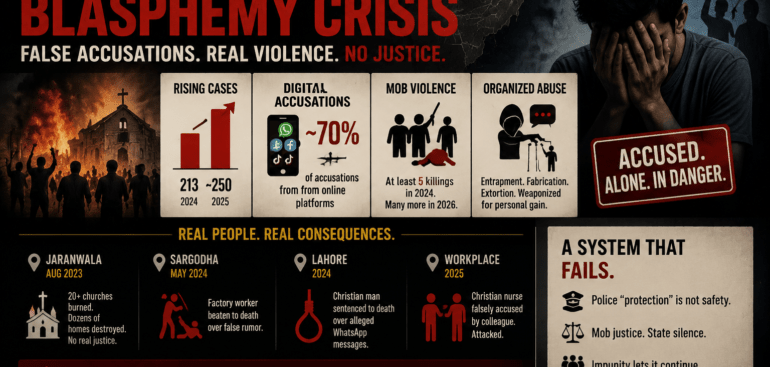
The numbers alone are telling. Around 213 cases were recorded in 2024, rising further in 2025 to an estimated 250. Early figures from 2026 suggest the trend is continuing. Alongside this increase is a persistent pattern of mob violence, including at least five killings in 2024 and multiple incidents already in 2026. These are not isolated episodes—they reflect a systemic failure to contain both legal misuse and vigilante enforcement.
The most significant shift is the move online. According to Pakistan’s National Commission for Human Rights (NCHR), roughly 70% of blasphemy accusations now originate from digital platforms such as WhatsApp, Facebook, and TikTok. This transformation has lowered the threshold for accusation. Screenshots—often unverifiable or manipulated—have become sufficient to trigger arrests or mob mobilization.
This digital turn has also enabled a more organized form of abuse. A 2024 Islamabad High Court ruling exposed networks commonly referred to as “blasphemy gangs.” These groups reportedly lure individuals into private conversations, extract or fabricate messages, and then use them for extortion or to initiate legal proceedings. The implications are severe: blasphemy laws are no longer only reactive tools but are increasingly part of premeditated schemes.
The enduring impact of the August 2023 Jaranwala attacks underscores the broader climate of impunity. In that incident, mobs burned over 20 churches and dozens of Christian homes following allegations of desecration. Three years on, accountability remains limited. Many victims have not returned, and prosecutions of perpetrators have stalled. The message is clear: large-scale collective punishment can occur without meaningful consequences.
Recent cases further illustrate how easily accusations escalate into violence. In Sargodha in May 2024, a factory worker was beaten to death over a rumor of Quran desecration that later proved unfounded. In Lahore, a Christian man was sentenced to death under Section 295-C based on alleged WhatsApp messages, despite claims that his phone had been compromised. Ahmadi communities have continued to face targeted attacks, with mosques vandalized or sealed under pressure from hardline groups. Even workplace disputes have turned lethal, as seen in the 2025 case of a Christian nurse accused by a colleague.
These cases are not only about religious tension. They also show a serious decline in basic legal standards and fair process. Many accusations—especially those based on online content—are not properly checked before leading to arrests or even mob violence.
Once someone is accused, it is very hard to escape the consequences. They often face arrest, long periods in jail, social isolation, and constant threat of violence.
The state’s role is unclear and inconsistent. Authorities often say arrests are for the accused’s “protection,” but even police custody is not always safe. Lynchings have happened near or inside detention. At the same time, the government is reluctant to challenge hardline groups like TLP, which weakens enforcement and allows mob justice to continue.
Equally concerning is the shrinking possibility of internal relocation. In the past, individuals at risk might have sought safety by moving to another city. Today, digital networks and informal information-sharing among religious groups mean that accusations can follow individuals across provinces. The geographic boundaries that once offered limited protection are increasingly irrelevant.
For international observers and asylum decision-makers, these developments matter. The rise in digitally triggered accusations challenges outdated assumptions about evidence and intent. A WhatsApp message—real or fabricated—can now carry the same consequences as a public act. Similarly, the notion that the Pakistani state can provide adequate protection is increasingly difficult to sustain given repeated failures to prevent or prosecute mob violence.
Pakistan’s blasphemy laws have long been controversial, but the situation is getting worse. What was once misuse is now becoming more organized and widespread. Fake or manipulated online content, planned entrapment, and lack of accountability have turned accusations into a weapon. Without stronger legal protections, real consequences for mob violence, and stricter evidence standards, this cycle will continue.
The result is a climate of fear that reaches far beyond religious minorities, but it is these communities—Christians, Ahmadis, and others—who remain the most exposed and least protected. In practice, blasphemy laws are not just punishing alleged offenses; they are enabling false accusations, settling personal scores, and reinforcing structural discrimination. Without urgent reform and real accountability, these laws will continue to be used not as instruments of justice, but as tools of persecution.