
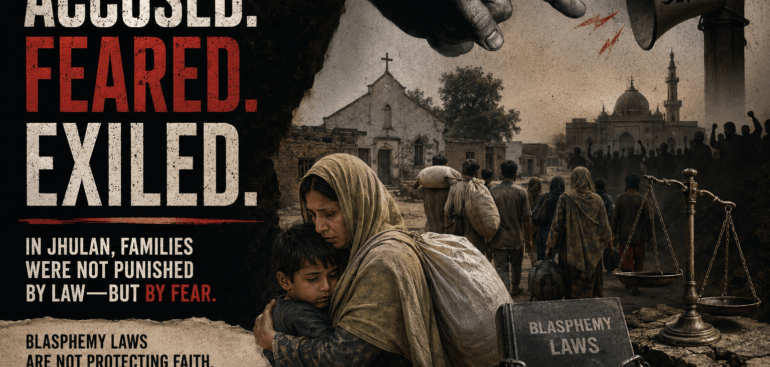
In the village of Jhulan, in Pakistan’s Punjab province, a recent blasphemy allegation has once again shown how vulnerable religious minorities are when accusations of religious offense arise. What started with announcements from mosque loudspeakers quickly grew into a crisis that forced more than two dozen Christian families to leave their homes, fearing mob violence.
The allegations focused on videos posted online by Pastor Sajeel Robin, a native of the village who now lives in the United States. The videos included religious debates and discussions on Islam that some local clerics found offensive. Although the pastor had not lived in Jhulan for years, the issue reached the village when his uncle, Shamaun Masih, and younger brother, Nabeel Robin, reportedly shared the videos in local WhatsApp groups. What was once distant and digital became immediate and dangerous.
In Pakistan, blasphemy is more than a legal charge—it is a social trigger. Even unproven claims can spark mobs, destroy neighborhoods, and force entire communities to flee before any legal process begins. In Jhulan, announcements by clerics created a sense of urgency and fear. Police from Kot Ladha arrived quickly and advised Christian families to leave as a precaution. Of the 35 to 40 Christian families in the village, most fled with only what they could carry.
Robin Masih, the pastor’s father, and Shamaun Masih were taken into protective custody. Nabeel Robin went into hiding. Their only fault was being related to the accused.
The situation was contained through negotiation. Village headman Muhammad Asif Gujjar, local police, and Muslim residents spoke with clerics, urging them not to harm innocent families. They stressed that legal processes, not mob justice, must decide the outcome. The relatives issued an unconditional apology and distanced themselves from the pastor. In return, clerics and community leaders signed a document “pardoning” the family. By the evening of July 4, displaced families returned home. On Sunday, they attended worship at the local Seventh-day Adventist church.
No violence occurred. No homes were burned. In today’s Pakistan, this is seen as a success.
But the lack of bloodshed should not hide the deeper harm. More than two dozen families were forced from their homes—not because of anything they did, but because of what others feared they might become. Their displacement was not caused by law, but by the social weaponization of blasphemy. Legal process came later; the first result was exile.
This incident reflects a wider pattern. Christians, who make up about 2 percent of Pakistan’s population, are disproportionately targeted under blasphemy laws that carry harsh penalties, including death. These laws are often misused to settle personal disputes, intimidate minorities, or assert power. Even when allegations are false, the damage is often permanent.
The 2023 violence in Jaranwala—where mobs burned more than 20 churches and 80 homes over false accusations—remains a stark warning of what can happen when such situations are not quickly contained. In Jhulan, timely action prevented escalation. But emergency response is not the same as justice.
Pakistan’s blasphemy laws remain a source of structural weakness. They empower accusers, endanger minorities, and leave entire communities at the mercy of public opinion. The state’s failure to reform these laws—or to protect people from collective punishment—keeps alive a system where fear is the normal condition for religious minorities.
In Jhulan, families have returned to their homes. But the question remains: how many more villages must live in fear before Pakistan admits that its blasphemy laws are not protecting faith, but enabling persecution?