The continued use of “honor” as a justification for killing women in Pakistan reflects a disturbing contradiction between law and reality. While legal reforms have attempted to curb such crimes, the persistence of these killings reveals a deeper crisis—one rooted in social norms, power structures, and weak enforcement of justice.
According to human rights data, at least 470 women were killed in so-called honor-related incidents across Pakistan in 2025, including 126 in Sindh province alone. However, activists caution that these figures likely represent only a fraction of the true toll, as many cases go unreported or are deliberately concealed as accidents or suicides. Behind these numbers are lives erased and families left in irreversible grief.
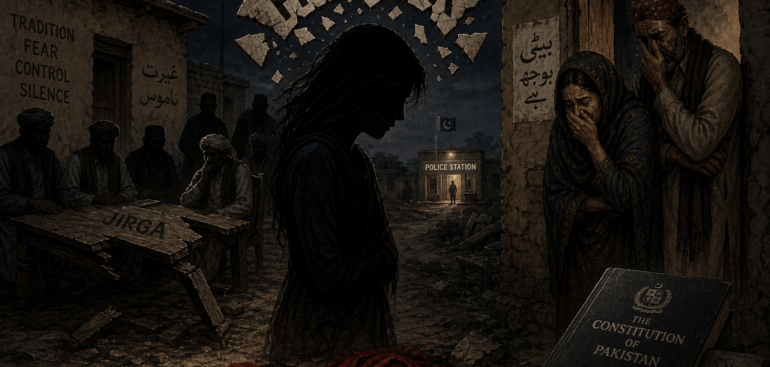
Among these cases is the killing of 20-year-old Khalida Chandio, whose death has become a symbol of both brutality and systemic failure. Living in Sindh, Khalida was accused of having an illicit relationship and brought before an illegal jirga—a tribal council that continues to operate despite being banned from adjudicating criminal matters. Declared “guilty” under the label of “kari,” she was forcibly taken from her home at night and shot dead, allegedly by her grandfather and uncle acting on the orders of local elders. The killing was filmed and widely circulated online, exposing the violence to a national audience and triggering outrage.
For Khalida’s parents, the tragedy is deeply personal. Her mother recalls the terror of that night and the unbearable pain of witnessing her daughter’s final moments through a video. Her father has questioned why, if there were accusations against her, she was not handed over to the authorities. His question underscores a fundamental issue: the replacement of lawful justice with informal, extrajudicial systems that operate beyond accountability.
Despite amendments to Pakistan’s laws in 2016 aimed at closing loopholes that once allowed perpetrators to escape punishment, implementation remains inconsistent. In many rural and tribal areas, jirgas and community elders still exert significant influence, often prioritizing tradition over legality. These parallel systems reinforce a patriarchal framework where women’s choices—particularly regarding marriage—are treated as violations of family control.
The problem extends beyond individual acts of violence. In some cases, accusations tied to “honor” are used strategically to settle disputes over land, inheritance, or tribal rivalries. Women become targets not because of proven actions, but because of their perceived role within these conflicts. This reveals that such killings are less about morality and more about maintaining control and power.
The impact of this violence reaches far beyond those who are killed. Women who survive threats of honor-based violence often live in hiding, cut off from their communities and burdened by fear and psychological trauma. Families of victims are left navigating grief within a system that frequently fails to deliver justice, further deepening distrust in state institutions.
Human rights advocates argue that legal reform alone is insufficient. Effective policing, protection mechanisms for at-risk women, and accountability for those who support or carry out such acts are essential. Equally important is challenging the societal acceptance that allows these crimes to persist. Without addressing the cultural narratives that equate control over women with honor, meaningful change will remain out of reach.
The story of Khalida Chandio is not an isolated incident; it is part of a broader pattern that continues to define the lived reality of many women in Pakistan. Each case raises the same urgent question: how long can violence be justified under the guise of tradition before it is recognized for what it truly is—a failure of justice and humanity?