
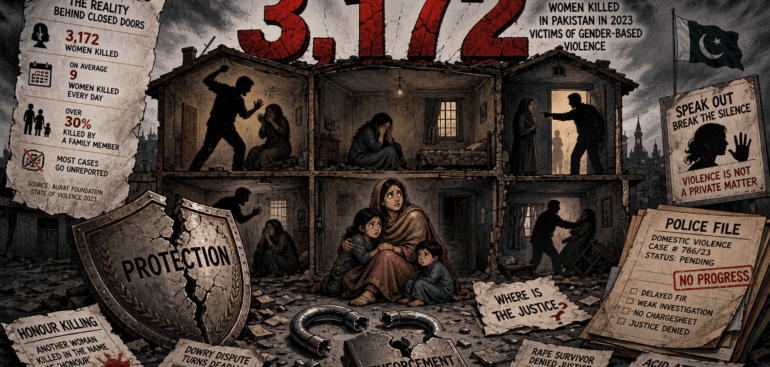
Pakistan is not just facing a rise in gender-based violence—it is witnessing a quiet emergency unfolding behind closed doors.
In the first six months of 2026 alone, at least 3,172 cases were reported. That number is difficult to absorb, but what it represents is even harder: thousands of individuals harmed, silenced, or lost in a system that too often looks away.
The brutality is not abstract. It is measured in lives. At least 644 people were murdered. Another 514 endured severe violence and torture. There were 462 abductions, 412 rapes, and 118 gang rapes. In 140 cases, lives were taken in the name of “honor.” Even within homes, 156 cases of domestic violence were recorded—though the true number is almost certainly far higher.
What is most unsettling is where these crimes happen. Around 54%—1,725 cases—occurred inside the victim’s own home. Another 12% took place at the abuser’s residence. The danger is not distant or unfamiliar. It exists within everyday spaces, often hidden behind family walls where victims are expected to remain silent.
And silence is part of the problem.
In 27% of cases, the perpetrator was someone known to the victim—an acquaintance, a neighbor, a familiar face. In 13% of cases, the accused was the husband. Fathers, brothers, and other relatives also appear in the data. These are not isolated acts of violence. They reflect a deeper crisis of power, control, and impunity.
Punjab alone accounts for 2,352 cases—74% of all reported incidents. Cities like Faisalabad (532 cases), Multan (256), and Lahore (237) stand out not just as urban centers, but as hotspots of vulnerability. Sindh reported 554 cases, while Khyber Pakhtunkhwa recorded 180. The rest were spread across smaller regions, where underreporting may be even more severe.
The age breakdown adds another layer of distress. Young women between 21 and 30 accounted for 334 cases, while 306 victims were between 11 and 20. Even children were affected—63 victims were under the age of 10. These are not just statistics; they are futures interrupted, often permanently.
The report also records 18 cases involving transgender individuals, reminding us that those already marginalized face compounded risks, with even fewer protections.
On the surface, there are signs of response—76% of cases (2,425 incidents) were registered with police. But numbers alone cannot capture reality. Hundreds of cases remain unclear or unregistered, and many more are never reported at all. Fear, stigma, and social pressure continue to keep victims from speaking out.
This is where the real crisis lies—not only in the violence itself, but in the normalization of it.
Pakistan has laws meant to protect women and vulnerable groups. Yet enforcement remains inconsistent, and justice often feels distant. Reports like this appear, generate brief outrage, and then fade. Meanwhile, the violence continues—quietly, persistently, and often invisibly.
3,172 cases in six months is not just a statistic. It is a warning.
If the response remains the same—slow, fragmented, and reactive—these numbers will not hold. They will grow. And behind every increase will be another life reduced to a headline, or worse, never recorded at all. Pakistan is not just facing a rise in gender-based violence—it is witnessing a quiet emergency unfolding behind closed doors.
In the first six months of 2026 alone, at least 3,172 cases were reported. That number is difficult to absorb, but what it represents is even harder: thousands of individuals harmed, silenced, or lost in a system that too often looks away.
The brutality is not abstract. It is measured in lives. At least 644 people were murdered. Another 514 endured severe violence and torture. There were 462 abductions, 412 rapes, and 118 gang rapes. In 140 cases, lives were taken in the name of “honor.” Even within homes, 156 cases of domestic violence were recorded—though the true number is almost certainly far higher.
What is most unsettling is where these crimes happen. Around 54%—1,725 cases—occurred inside the victim’s own home. Another 12% took place at the abuser’s residence. The danger is not distant or unfamiliar. It exists within everyday spaces, often hidden behind family walls where victims are expected to remain silent.
And silence is part of the problem.
In 27% of cases, the perpetrator was someone known to the victim—an acquaintance, a neighbor, a familiar face. In 13% of cases, the accused was the husband. Fathers, brothers, and other relatives also appear in the data. These are not isolated acts of violence. They reflect a deeper crisis of power, control, and impunity.
Punjab alone accounts for 2,352 cases—74% of all reported incidents. Cities like Faisalabad (532 cases), Multan (256), and Lahore (237) stand out not just as urban centers, but as hotspots of vulnerability. Sindh reported 554 cases, while Khyber Pakhtunkhwa recorded 180. The rest were spread across smaller regions, where underreporting may be even more severe.
The age breakdown adds another layer of distress. Young women between 21 and 30 accounted for 334 cases, while 306 victims were between 11 and 20. Even children were affected—63 victims were under the age of 10. These are not just statistics; they are futures interrupted, often permanently.
The report also records 18 cases involving transgender individuals, reminding us that those already marginalized face compounded risks, with even fewer protections.
On the surface, there are signs of response—76% of cases (2,425 incidents) were registered with police. But numbers alone cannot capture reality. Hundreds of cases remain unclear or unregistered, and many more are never reported at all. Fear, stigma, and social pressure continue to keep victims from speaking out.
This is where the real crisis lies—not only in the violence itself, but in the normalization of it.
Pakistan has laws meant to protect women and vulnerable groups. Yet enforcement remains inconsistent, and justice often feels distant. Reports like this appear, generate brief outrage, and then fade. Meanwhile, the violence continues—quietly, persistently, and often invisibly.
3,172 cases in six months is not just a statistic. It is a warning.
If the response remains the same—slow, fragmented, and reactive—these numbers will not hold. They will grow. And behind every increase will be another life reduced to a headline, or worse, never recorded at all.