
Another week, another series of horrifying headlines. Children tortured, raped, and killed — many inside institutions meant to protect them. The recent spate of abuse cases in Punjab is not an anomaly. It is a reflection of a system that continues to fail its children, again and again.
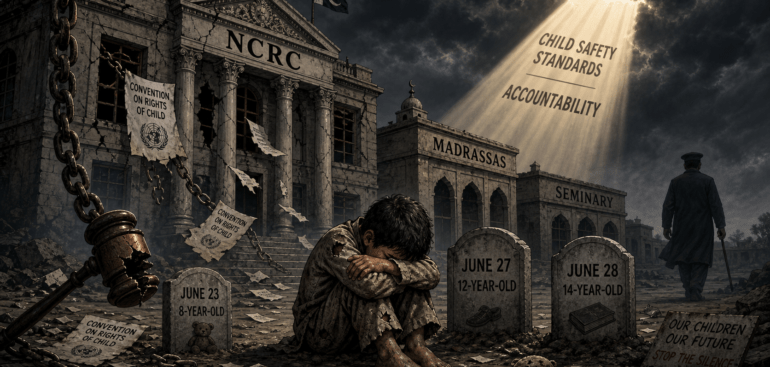
On June 28, a madrassa student in Lahore was brutally tortured by his teacher and others. Just a day earlier, on June 27, a 12-year-old student in Lahore’s Cantonment area died after suffering severe abuse inside his seminary. Police have arrested the teachers involved in both cases.
That same day in Khushab district, a prayer leader was arrested after allegedly being caught in the act of raping a minor boy in a room adjoining a mosque.
Only days before, in Kasur’s Rao Khanwala village, an eight-year-old boy died at a seminary where he lived and studied. Initial autopsy findings suggested possible sexual abuse, with final confirmation pending forensic analysis.
In Sargodha, the brutality reached even more disturbing levels. A 14-year-old boy was allegedly buried alive after reporting that he had been sexually abused; three suspects, including the alleged ringleader, have been arrested. In another case, on June 23, an eight-year-old girl was raped and murdered on the rooftop of a building. Investigators say a helper from a shop below lured her upstairs. The suspect was later killed in a police encounter, raising further concerns about transparency and justice.
These are not isolated tragedies. They reveal a pattern — one rooted in neglect, weak oversight, and a failure to put children’s safety at the center of governance.
The National Commission on the Rights of the Child (NCRC), which has taken suo motu notice of 11 such cases, has described the situation as a systemic crisis. Its recommendations are clear: strict monitoring of madrassas and all child-care institutions, mandatory safeguarding standards, staff vetting through a sex-offender registry, and formal reporting protocols.
But the question is unavoidable: why are these basic protections still missing?
Many madrassas and similar institutions continue to operate without effective oversight. There are no consistent safety standards, no reliable complaint systems for children, and little accountability for those in positions of power. The state intervenes only after abuse has occurred — after a child has already suffered, or died.
This is not just institutional failure. It is a societal one.
Silence around abuse, reluctance to question authority figures, and the absence of open conversations about child safety all contribute to an environment where such crimes can continue. Children are often left unaware, unprotected, and unheard.
The NCRC has also called for child-friendly complaint mechanisms, psychosocial support for victims, trained law enforcement, and a national action plan aligned with international commitments under the Convention on the Rights of the Child. These are essential steps — but they remain largely unimplemented.
Pakistan’s failure is no longer about lack of awareness. It is about lack of action.
Each case follows the same cycle: shock, outrage, arrests, and then silence — until the next incident. Meanwhile, the cost continues to rise, measured in children’s lives and broken families.
How many more children must be tortured before safeguarding becomes mandatory? How many more must be buried before oversight is enforced? How many more must suffer before the state moves from reaction to prevention?
Protecting children is not optional. It is a fundamental responsibility.
Until Pakistan confronts its failures — institutional, legal, and social — these tragedies will continue to repeat.
And each time, the question will remain the same:
How many more?