
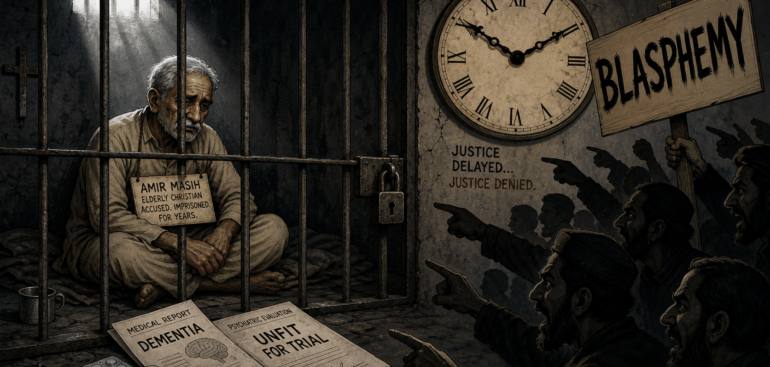
Amir Peter should have spent his final years in peace. Instead, the 61-year-old retired government employee died behind bars—accused, unheard, and never proven guilty. His death on July 1, 2026, is not just a personal tragedy; it is a stark indictment of a system where accusation becomes punishment, and delayed justice quietly turns into a death sentence.
For over four decades, Amir Peter lived an ordinary, honest life in Lahore’s Nishat Colony. A father, a neighbor, and a member of Pakistan’s Christian minority, he was part of the country’s social fabric. But all it took to unravel that life was a dispute over the price of groceries.
What began as a routine argument with a shopkeeper escalated dangerously. Following a verbal altercation—reportedly involving physical assault—the shopkeeper accused Peter of blasphemy under Section 295-C of the Pakistan Penal Code.
No clear statement. No credible evidence. Just an allegation. And in Pakistan, that is often enough.
From that moment, Amir Peter’s fate was no longer his own. Arrested and imprisoned, he became another name in a growing list of individuals—many from religious minorities—trapped in a legal and social nightmare triggered by blasphemy accusations.
His family maintained his innocence. Human rights advocates pointed to serious gaps in the FIR, including the absence of any specific blasphemous remark. Yet this was not enough to secure his release. In such cases, the process itself becomes the punishment.
As months passed, Peter’s health deteriorated rapidly. Doctors later confirmed he was suffering from advanced dementia—so severe that he was declared mentally unfit to stand trial. At that point, the law should have acted with urgency and compassion.
His lawyers filed for bail on medical grounds. A hearing was scheduled. Evidence was prepared. But time was not on his side, and the system moved too slowly. He died before the court could even consider his release.
This raises difficult questions: What does justice mean in a system that cannot act before a vulnerable detainee dies in custody? What purpose does a trial serve when the accused does not live to face it? And what accountability exists when the justice system fails so completely?
Amir Peter’s case is not isolated. It reflects a broader, deeply entrenched pattern.
Pakistan’s blasphemy laws, particularly Section 295-C, are often misused to settle personal disputes and target minorities such as Christians, Hindus, and Ahmadis. Minor conflicts can escalate into serious accusations, where allegations alone trigger threats, violence, and prolonged detention. A slow and pressured judiciary further undermines timely justice, making due process unreliable.
For someone like Amir Peter—elderly, ill, and marginalized—the system offered no urgency, no protection, and ultimately, no justice.
There are also troubling allegations that he was pressured to confess to a crime he consistently denied. If true, this reflects a deeper failure: a system where coercion can replace evidence, and the presumption of innocence is eroded.
His death leaves behind a grieving family—but also a question Pakistan can no longer ignore:
How many more must suffer before meaningful reform is taken seriously?
Justice is not only about laws on paper. It is about how those laws are applied, how quickly courts act, and whether the most vulnerable are protected.
Amir Peter was not given that protection. He was given delay, detention, and silence.
If his story fades without consequence, it will not just be a failure of memory—it will be a continuation of the injustice that cost him his life.
The real test now is whether this tragedy becomes a turning point—or just another name on a growing list of those who never lived to see justice.