
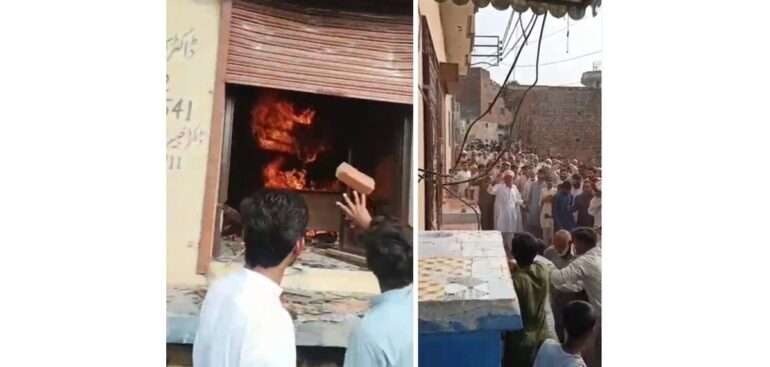
A mob burned a Christian man’s home and small pharmacy in Pakistan’s Punjab province on Friday, October 9, after accusations that he shared blasphemous material online. More than 35 Christian families fled the village because they feared further attacks. The violence left a community afraid to remain in its homes.
The attack took place in Gharial Kalan village near Narang Mandi, in Sheikhupura district. Police had arrested Kamran Gul Masih, a 40-year-old father of three, the previous evening. Local residents accused him of sharing a video in WhatsApp groups that they considered offensive to Islam.
The allegations remain unproven. Reports said police registered a case, but the exact sections of the blasphemy laws used against Masih remained unclear. His arrest does not establish guilt. A court must examine the evidence and decide the case.
As news of Masih’s arrest spread, his family and other Christian residents began leaving the village. They feared that an angry crowd would target their homes, even though the accusation concerned only one man.
Their fear soon became a reality. On Friday, dozens of protesters gathered outside Masih’s pharmacy and adjoining house. Some members of the crowd set both buildings on fire, damaging his home and the business that supported his family.
A source said police stopped the crowd from attacking other Christian properties. Authorities also sent more officers to the village to protect residents and prevent further violence.
Punjab Assembly member Ejaz Alam Augustine said police arrested more than 15 people accused of taking part in the arson. He said Christian lawmakers stayed in contact with police and local officials throughout the day.
These steps helped limit the attack. However, families had already left, and Masih’s property had already burned. Restoring order cannot undo the damage or immediately remove the community’s fear.
Human Rights Focus Pakistan condemned the incident. Its president, Naveed Walter, said no allegation could justify mob violence, arson, threats or punishment of an entire community.
He urged authorities to protect Masih, his relatives and other Christian residents. He also demanded legal action against those responsible for the attack.
The distinction is clear: police must investigate the allegation against Masih, while also investigating those who burned his property. One accusation cannot excuse another crime. A crowd has no right to decide guilt or carry out punishment.
Masih’s relative said Christians and Muslims had lived peacefully together in the village. He described Masih as a respected man and expressed shock at the violence.
His account adds to the sadness of the incident. Neighbours who had shared daily life now face fear and mistrust. For families who fled, the loss extends beyond buildings and belongings. They have also lost their sense of safety.
The attack reflects a wider problem: Pakistan’s blasphemy laws can put religious minorities at risk before courts examine the evidence. The August 2023 attacks in Jaranwala showed how an accusation against individuals can trigger violence against entire Christian communities.
Critics warn that people misuse these laws to settle personal disputes, while threats and mob pressure weaken fair trials. For minorities, an allegation can mean arrest, a destroyed livelihood or flight from home, regardless of guilt.
Authorities must investigate accusations fairly, prosecute attackers and help displaced families return safely. Arresting the accused cannot replace protecting those threatened by violence.
For Gharial Kalan’s Christian families, official promises mean little without lasting protection. Laws meant to defend religious beliefs must not become tools of fear. No accusation should give a crowd permission to burn homes or punish a community.